
Don’t you ever ask them why, if they told you, you would cry, so just look at them and sigh, and know they love you.**
As I write, I am less than a week out from a wonderful visit from my beautiful 20-year-old daughter. The short time spent with her was marvelous, split between gaping in awe at the wonders of ancient Egypt and gasping in fear through a shared binge of streamed horror flicks, with a Christmas viewing of the new Star Wars (in IMAX 3D!) and a sampling of Egyptian cuisine sprinkled in for good measure. Having her here was a true gift, bringing much happiness and a needed dose of just plain fun. Letting her go after the all-too-short stay was tough, but I knew she’d had a blast and I was pleased to have been able to give her the experience of seeing in person places such as the Great Pyramids of Giza that serve as near-global cultural touchstones. It was a great bonding time and reinforced how truly lucky I am to be a father and to be able to provide my kids opportunities to expand their horizons.

My girl throwing up her gang/cult sign (Kappa Delta sorority) at the Great Pyramids in December 2015.
I’m also remembering today a previous excellent, horizon-expanding cultural experience shared with my daughter. To further misappropriate the beautiful Graham Nash lyrics that give title to this post, in May of the year just passed, I sought to share something of the code I live by with my youngest child. Always up to humor Dad, intrepid daughter agreed to accompany me on the three-hour road trip from the Washington D.C. area south to Richmond, Virginia, to see a rock show. This was not her first such rodeo as she previously rode along for concerts by Brazilian thrash/groove metal legends Sepultura (written about here) and Finnish valkyrian “opera metal” belter Tarja Turunen (formerly of Nightwish) back in our Bolivia days. Sticking with the international flavor of past outings, this time we were off to see Icelandic post-metal cowboys Sólstafir in a small club called Strange Matter in what was once the capital of the short-lived Confederate States of America. Happily, disunity was nowhere to be seen on this night as the shared global bond of heavy metal harmony proved as strong in southern Virginia as everywhere else I’ve been blessed to bang my head.
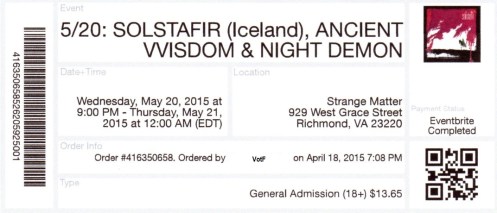
The crowd was small at Strange Matter, numbering only about 40-50 people, for what we learned was to be Sólstafir’s final show of this particular North American tour. Despite the low turnout, the intimacy of the venue, with its small stage and stagefront area, helped protect against any sense of sparseness in the gathering. Installed against the bar at the back of the open space in front of the platform, daughter and I were still only about 20 feet from the stage. Despite representing the youngest and oldest ends of the spectrum present, we were quickly able to establish a sense of comfortable community with our fellow audience members as we settled in for the show.
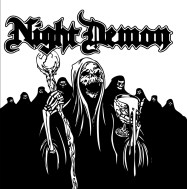 I’ll note that opening band Night Demon, long-suffering metallers from California, gained in me a life-long fan via their non-ironic embrace of old school heavy metal swagger and unabashed delivery of tales of devils and werewolves over galloping riffs and soaring solos. Because their charging demon army riffage differs so greatly from the windswept wall of sound of the headliners and because I really, really liked them and therefore want to avoid short-shrifting, I’ve decided that Night Demon deserve their own (eventual) post however, and so will leave them here with solely this inadequate, but hearty endorsement.
As the time came for Sólstafir to play, the band members sort of ambled onto the stage and simply meandered about at first, unhurriedly adjusting knobs and languidly picking up their instruments. With blue backlighting and soft white illuminating them from the front, the mood evoked was that of a cold winter’s dusk as the first slowly-strummed chords of opener “Dagmál” eventually began to fill the space. Tall and lanky, with shoulders seeming to slump permanently forward, vocalist/guitarist Aðalbjörn Tryggvason eventually stepped to the microphone and began to mournfully croon unintelligible (to us) Icelandic lyrics that conjured visions of solitary suffering in the midst of harsh, but beautifully vast natural landscapes. As Sæþór Maríus Sæþórsson’s guitar and Svavar Austmann’s bass combined with Tryggvason’s own guitar to create a wall of sound on which to layer the variously wailed or moaned vocals, the tone for the evening was made plain. We were plummeting through the endless expanse of space on an immense terrestrial ship, secured helplessly to a rock-encrusted hull that barely contained the boiling, molten engine at the vessel’s core both propelling us forward and warming us against the cold surrounding bleakness.
Three songs known to me from Sólstafir’s fantastic 2014 album Ótta (which I wrote about here) opened the concert, but the set list didn’t really matter. The band’s ability to create atmosphere carried across songs, making the show one overall event rather than a joined collection of individual performances. Looking over at my decidedly non-headbanger daughter at various times during the concert, I could tell that even she was successfully drawn into the voyage. Tryggvason’s limited engagement with the audience, to include an acoustic moment sitting amongst us on the stairs alongside the stage, was that of a fellow traveler rather than a guide. During the one point in the show when the moment was broken as Tryggvason felt the need to ask the non-participants behind us at the bar to stop clinking their glasses, we were right there with him, desperate to suppress any distractions that might snap us out of our shared excursion. We were lost in the journey, oblivious to any path or ultimate destination.
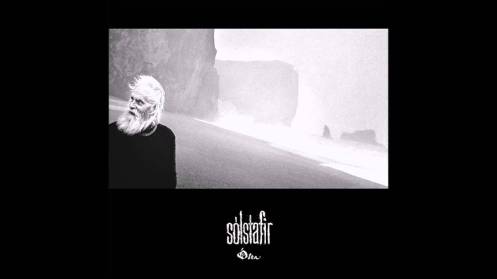
Whether traveling back in time in the form of visits to ancient temples and tombs of pharaohs and queens, or hurdling through the cosmos on shared musical voyages, there’s little better than sharing moving personal experiences with loved ones. Some of the best times I’ve ever had have involved sharing moments of culture, music, history, and entertainment with my kids. As such, today I jointly offer sincere, heartfelt thanks to fourth dynasty Egyptian Pharaoh Khufu and Icelandic progressive post-metallers Sólstafir for unique, individual contributions to some awesome daddy-daughter bonding in 2015.
** quoted lyrics from “Teach Your Children Well” by Graham Nash
============================================
The following clip embedded from YouTube is a different show than that described here but provides a general sense of the goodness:
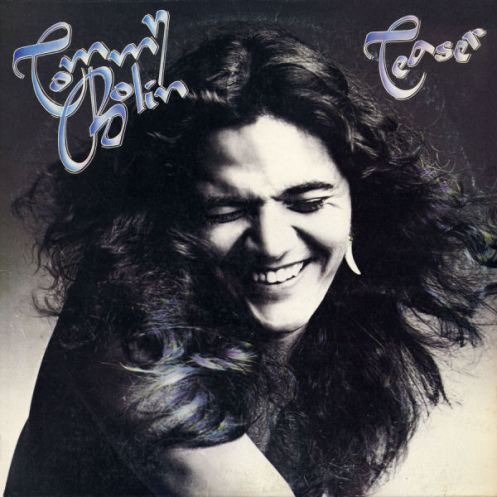
 floated my teenage boat, as did what I would have described at the time as the “with feeling” soloing in “Wild Dogs” and “Lotus.” Back then it was always all about the hard-rocking electric guitar for me and Teaser most definitely did not disappoint on that front even as it surreptitiously expanded the self-imposed boundaries of my musical tastes to insinuate a little jazzy funk fusion. (I note here that among the many amazing players contributing their talents to this LP were Jan Hammer and David Sanborn on a pair of songs!)
I feel down today. I woke up to a life that had missed its turn many miles back and was now so far off its intended path as to make reversing course to find the untaken fork impossible. Feeling excruciatingly foreign, I play at countering reasonless, fanatic beheaders from behind a suit-and-tie bureaucrat’s desk at an age when my younger self fantasized I would be eloquently and convincingly extolling the merits of my liberal worldview over cold lemonade with William F. Buckley. Far removed from the tiny clutch of family and friends who so charitably care about me, I am desperately lonely but nonetheless so fully given over to my hermit introversion that I stridently choose drawn-curtain solitude over a walk in the sun for fear of being forced into a passing exchange of greetings with a too-eager doorman upon exiting the elevator. I can’t bring myself to answer welcome, wonderful overnight emails from daughter, uncle, and long-lost friend because I am unable to imagine words I could type that would successfully escape the deep hole from which they were sprung.
It is goddamn glorious! Every inch of my skin tingles with the electricity of sweeping misery. The daydream visions behind my closed eyelids flicker in extreme high definition; so palpable I sense I could step into and live inside them if I could only find the right footing. I am a bundle of rapidly firing synapses, my jittery thoughts somehow transmitting both trillions of bytes and nil data sets concurrently. I spent an hour and a half on the elliptical just now, and could have easily done double or triple that. The usual day-to-day cloud of numbness is banished. I feel alive in my despair, brutally and magnificently alive!
Musically, there is but one option, albeit one I find myself unable to properly set to paper in my present state. Happily, back in March 2013, some long-forgotten and in-all-likelihood fictitious person claiming my name managed to put the story to words. I’ll let him tell it again this time:
===========================================
As an accompaniment to pitch black or candlelit tread-milling, it is hard to imagine a more effective conveyance. Within minutes your consciousness is transported into a land of perpetual night, foggy-marsh stone castles, and loam-covered knolls. The castles host a maze of shadowy passageways lit by flickering torches, a few wrought iron adornments affixed to otherwise bare walls. You instinctively make your way towards the faint glimpses of a ghostly maiden that tease your peripheral vision in the twilight. Her flowing hair, flowing gown, and flowing desire tantalize you, but she is continually beyond reach, not in mocking but rather sharing despair at the futility of your attempts to join her. With each failure, your need for her grows until you can think of nothing else. Only she matters. You sense an inexplicable yet timeless connection. You can discern not where or when but you know that you were are soul mates.
She has been taken from you unjustly and your love, no that’s not strong enough, your longing for her is all-encompassing. Eventually you realize that she is being kept from you by otherworldly powers against which you have neither recourse nor remedy. They care not for your suffering. Your desperate pleas for compassion fall on deaf ears. Despite the bottomless depths of your anguish, to them you are naught but an insignificant midge, unworthy of even a moment’s thought. You cast yourself to the stone floor in hopelessness, doomed to forever haunt these nocturnal halls and hills with your beloved just beyond your grasp. You yearn for Death to take pity and end your torment, but it will never be. Your sorrow is eternal. You are crushingly alone, with no one to lament your circumstance nor even to take pleasure at your woe. You are inconsequential, and yet your pain fills the universe. Please. End. This.

Such is the awesome splendor of English doom metal band My Dying Bride. Their music is the perfect soundtrack for solitude, albeit not the reassuring solitude of sunny forests filled with chirping birds and gleaming, dew-covered leaves. This is music for dark, lonely rooms and extended solo road trips through desolate landscapes. This is music through which to escape the misery of one’s own earthly isolation by subsiding into the deeper, blanketing gloom of the vast, empty cosmos.
Joy is to be found here; the joy of recognizing one’s own utter irrelevance, the joy of realizing that there is no greater scheme, the joy of seeing that one’s personal suffering, while wholly unavoidable, serves no larger purpose. My Dying Bride represents liberation from the shackles of hope. There is true, boundless beauty in the abyss. Come. Join. Us.
The Light at the End of the World:
I surprised myself the other day with an unconscious and completely rote action designed to protect my “cool” as if I were back in high school expecting to be judged on my every move. I had ordered two CDs which, given my current overseas assignment, arrived via  mail to my place of work vice my home. I took the envelope to my office to open it, admired my newest acquisitions, and then placed the CDs on a corner of my desk, taking care to put Motörhead’s Bad Magic on top of REO Speedwagon’s You Can Tune a Piano, But You Can’t Tuna Fish. Almost immediately after doing so, I realized that I had placed the CDs in that way purposefully, albeit automatically, so that passersby would see the Motörhead and
 judge me edgy rather than glimpse the REO Speedwagon and deem me lame. I laughed at the silliness of a 50-something ridiculously still motivated to hide parts of his true self in order to fit in with the cool kids. Even so, I nonetheless absolutely left the Motörhead covering the Speedwagon throughout the remainder of the day.
REO Speedwagon became anathema to me and my rocker friends in 1980 following the release of their gazillion-selling LP High Infidelity with its more pop-oriented, power ballad-laden sound as compared to the band’s earlier offerings. Having so many girls and parents singing along to the multiple hits from the album as they played on a  seemingly endless loop on Top 40 radio was too much for our earnest hard-rock sensibilities. REO Speedwagon was dead to us. You might as well have asked us to listen to Captain & Tennille or Barry Manilow as publicly show any love for the Speedwagon at that point.
(The truth, of course, is that I secretly sang along to those catchy new REO songs along with everyone else, although only when everyone else was looking the other way.)
In the days before the great REO excommunication from the True Church of Real Rock, they had made what is, in my opinion, one the greatest live hard rock albums of all time; 1977’s Live: You Get What You Play For. I’d list it among the best live non-guitar-hero rock guitar records ever, filled to the brim with impeccable interplay between lead and rhythm guitar, unique electric fills, and mouthwatering solos all in service of an overall groove vice being crafted to steal attention. It is also one of the best mixed live albums from the era, with the recording and separation of the individual instruments and vocals accomplished in a way that emphasizes each individually without overwhelming or flattening the others. I have no idea whether any studio trickery was used to get the sound right or “fix” any performance flaws, and to be honest I don’t care. All I know is that this is an album that, especially on headphones, resonates with in-the-moment band chemistry.
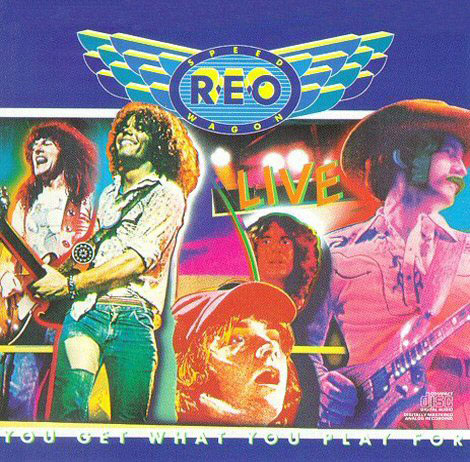
This is an optimistic album, with every song exuding happiness and hope, even in the face of difficulty. The lessons of “Any Kind of Love,” “Being Kind (Can Hurt Sometimes),” “(Only a) Summer Love,” and “Son of a Poor Man,” all of which are love songs about imperfect or finished relationships, are about finding and focusing on the good in the midst of bad moments. No regrets, laments, or depression here, rather the earned sadness is tinged with hope and gratitude for the silver linings. “Keep Pushin’” and “Riding the Storm Out” state it outright in their titles and then reinforce it ferociously in their execution; this is music that looks toward a welcoming, if hard-earned, bright future. Even the biting social commentary on our apathy toward the suffering of our human brethren in “Golden Country” is couched in an expectant message of faith in an ability to change for good. REO Speedwagon knows we can do better and honestly and compassionately expects nothing less from us.
Another aspect of this album deserving praise is the excellent infusion of hard rock piano into many of the songs. Keyboard player Neil Doughty is great throughout, but it is when he sticks with basic acoustic piano that I find myself most moved. His tinkling of the keys on “Any Kind of Love” and “Keep Pushin’” demonstrate once and for all that thumping rock and roll piano didn’t stop with Jerry Lee Lewis and Fats Domino.
(A funny aside: I apparently had gotten so used to seeing lead singer Kevin Cronin sitting at the piano for all those Hi Infidelity and beyond syrupy REO ballads that I thought he was playing the keyboards here. It is only as I write this that I discover he was actually the kick-ass rhythm guitarist on this kick-ass rhythm guitar album. Respect!)
I must acknowledge that mega-classic “Riding the Storm Out” deserves its own paragraph here. Like Lynyrd Skynyrd’s “Free Bird,” Danzig’s “Mother,” or Procol Harum’s “Conquistador,” this is a song for which the better-known live version so thoroughly crushes the studio counterpart that it might as well be considered a completely separate piece of art. From the air raid siren opening to the ending cacophony, “Riding the Storm Out” is a master class in “Rock.” The simple, bombastic riff, sing-along chorus, uplifting lyrics, and the melodic-as-hell sizzling extended guitar soloing by Gary Richrath combine to make it the cultural touchstone I believe it has become for my generation.
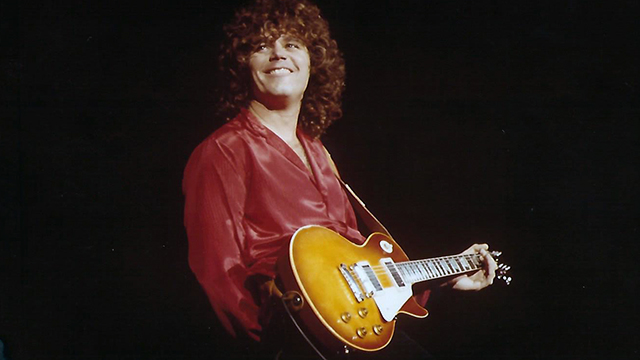
Gary Richrath – PHOTO: Ross Marino 1980 (from http://www.guitarplayer.com)
REO Speedwagon lead guitarist Gary Richrath passed away on 13 September 2015 at the age of 65. Among the obituaries, eulogies, and news reports, I’ve seen photos of him from recent years in which he looked severely unhealthy. I choose to remember him young and vibrant. I imagine only a minority of people would have known his name now, or even back in REO Speedwagon’s glory days. REO Speedwagon was always more about being a band than a group of individuals to me, and while I knew “Gary” to be a monster guitar player mainly from the album reviewed here, I personally never thought of him individually in guitar-hero terms. To me, he was a talented player, composer, sometime-singer and awesome band member. That said, as I’ve listened to Live: You Get What You Play For on the headphones today, I’m realizing ever more what a force he was personally in this great, hard-rocking band. Besides being a creator of highly melodic electric guitar solos full of “feeling,” he was a master of what I’d describe as the “wicka-wicka” fills, those crunchy half-note, staccato strums that purposefully avoid sustain and give the music a wonderful bounce. In honor of Gary and as thanks for the moments of joy he has brought and will continue to bring me, here’s the live “Lay Me Down”:
I’m sure there is science to explain how and why some songs manage to insert themselves so deeply into my being that I can hardly remember a time when they were not part of my life. I imagine the explanations might reference the lasting impact of early assertions of adolescent independence and discovery in personal development, similar to how the first steps in a long journey take on greater historical importance after the destination is reached. In cases where they are discernible in retrospect, it is natural to look back with a little awe and reverence at those tentative initial strides that set one on the path to now. It all makes utter sense; I get it. The happy firing of synapses in my brain whenever I hear the three songs below almost certainly reflects the deep tracks they carved into my evolving brain at a time when titillation moved my mountains. “Sex, drugs and violence, Mr. Clark, and er, a great beat to dance to.”
Does it truly matter however why certain songs float my emotional boat, or is it enough merely that they do? Sure, being able to cite environmental/developmental factors can provide a salve for the misguided shame I can still feel despite myself when admitting to my unabashed love for what might otherwise be considered insubstantial dreck by some. On the other hand, maybe science should go jump in the lake. What say instead we all simply agree that the following three songs objectively represent some of mankind’s greatest achievements and move forward from there?
===============================================
Dark Lady – Cher
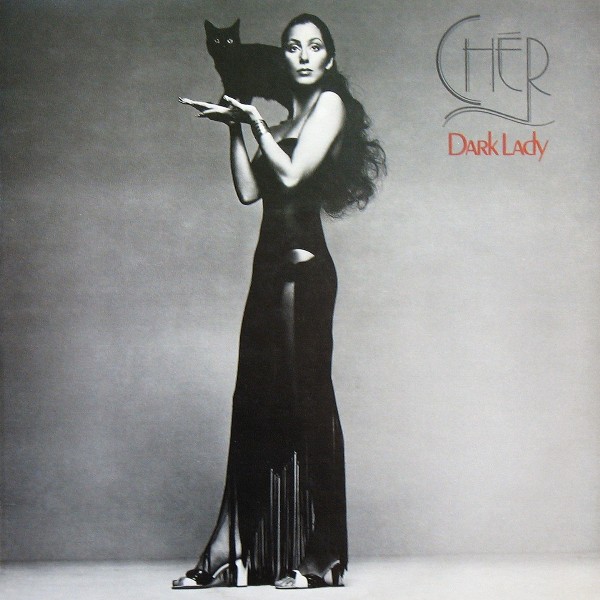
Right from the mournful opening violin/clarinet lines, this tune pulls me in. Cher’s lower register voice with that dramatic vibrato really connects, especially when coupled with the unique combined bass and piano pulling the verses forward toward the strident strings that proclaim the chorus. Add in a lyric that rates for me as one of the best short-form story songs of all time, and I view this as a true pop masterpiece. The song’s ability to successfully carry the listener through shifting feelings of dread, menace, discovery, and cathartic vengeance all in the course of an oh-so-brief three and a half minutes is striking.
Cher released this one in my tenth year and I’m unsure where I first heard it. It could have very well been via the performance broadcast on the Sonny and Cher Comedy Hour in late 1973 that is embedded below, or it may have been on the radio in early ’74 as it made its way to the Billboard number one spot it attained in March of that year. However I became aware of it, I was enthralled. My parents bought me the 45 rpm single, which my 2-years-younger sister and I played incessantly on my portable record player, learning all the words and singing along blissfully to its tale of passion, infidelity, and murder. To this day, I think Cher’s inflection on the word “dead” as she sings the line “next thing I knew they were dead on the floor” is super sexy cool.
While the Dark Lady-era allure of Cher to my 10-year-old self was pretty innocent, I unashamedly acknowledge that subsequent years saw me captivated much less virtuously. Cher was my first celebrity infatuation, causing pubescent tremors that preceded and surpassed even the great Farah Fawcett palpitations of ’76-’77. While I’m not sure I’d want to delve into the psychology of it too deeply, it is the case that I eventually ended up marrying my own tall, thin exotic dark lady with long flowing black hair a decade and a half later.
Dark Lady:
===============================================
The No-No Song – Ringo Starr
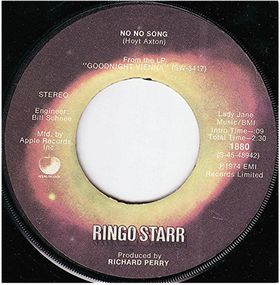
A former Beatle singing a catchy tune about booze and drugs, with appended guest shout-outs from another former Beatle; how could it not be awesome? (That is John Lennon inserting brief yelps into the second and third verses, right?) This was another 45 rpm single I convinced my folks to purchase for me in 1974, the year the song was released. There’s nothing deep about this one. It’s easy to sing along to and its marijuana, cocaine, and moonshine references felt excitingly naughty to a pre-teen Victim of the Fury.
The No-No Song:
===============================================
Hot Child in the City – Nick Gilder
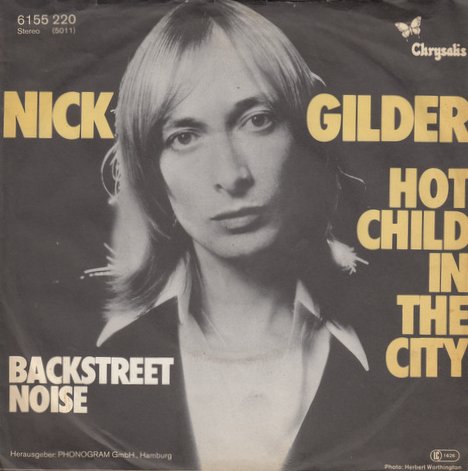
By the time this one came out, I was a full-on hard rocker, dues-paying member of the KISS army, and missionary crusader calling all who had ears to hear to worship at the altar of guitar heroes Ronnie Montrose and Robin Trower. Back then I would have normally slagged off the catchy pop stylings and pretty-boy promotion of such Top 40 singles but there was something different about this one. The mix of the bass-driven first stanza in the verse, followed by the simple-but-effective electric guitar in the second stanza sounding as if it was coming out of the most basic beginner’s practice amplifier, was unique. Add to it the suggestive lyrics about a “loose” hottie attracting the attention of all the boys and who apparently could be invited to one’s place to “make love” and it’s not such a mystery why this song and its gritty, neon-lit atmosphere appealed to me.
I still like this song but admit to feeling a little queasy listening nowadays as Nick croons about the “so young … hot child” protagonist. Wikipedia tells me Gilder wrote it about his experience witnessing child prostitution in Hollywood. Says Nick in a Rolling Stone interview from the era, “I’ve seen a lot of young girls, 15 and 16, walking down Hollywood Boulevard with their pimps. Their home environment drove them to distraction so they ran away, only to be trapped by something even worse. It hurts to see that so I tried writing from the perspective of a lecher – in the guise of an innocent pop song.” All of that was completely lost on me at age 14 however; the song simply sounded sexy, cool and provocative, and it was that more innocent reading that was ingrained in me. I experience it still today as one of the “young boys (who) all want to take her home,” although I do harbor grown-up discomfort with the alternate, albeit unheard, evil depraved bastard perspective.
Hot Child in the City:


 Victim of the Fury