
I was 10 years old when I went on my first killing spree…
Bow hunting was an important annual activity for my family when I was growing up. We’d pack up the camper and drive for about three hours, heading east through the canyons out of Ogden, Utah, traversing the Wyoming badlands, and crossing back into Utah to enter the Ashley National Forest. There we’d meet up with my uncle and aunt and a group of three or four other families. During the week or so camping in the vicinity of Spirit Lake, we’d spend early mornings and evenings hunting for mule deer along seemingly endless dirt roads.
I was the youngest of the relatively older kids at the camp and spent a lot of time trailing around behind three or four teenagers. I was old enough to keep their marijuana-toking secret and harbor prepubescent impure thoughts about my cousin Tammy, but too young to be much more than a mascot for them. When not tagging along with the big kids, I passed much of my time wandering through the forest pulling down dead saplings or using a heavy stick to knock dried branches off of fallen trees.
The times were good. I fondly remember gathering around the large campfire after dusk to listen to the adults tell exaggerated stories of past hunting and fishing conquests. I also recall being amazed at the experienced hunters’ ability to track a wounded buck over large distances via the scant blood droplets left on scrub brush and pine needles that covered the ground. I wanted to be like them. Eventually the call of the wild beckoned and, in the summer of 1974 at the age of 10, I was moved to trek alone into the quaking aspens to prove myself a great hunter.
My first bow was a flimsy yellow fiberglass deal I used to shoot cheap wooden arrows with plastic feathers. I had practiced with it extensively, mainly targeting hay bales and tree stumps. As I skulked through the woods that day, I was imposingly kitted out with a faux buckskin quiver attached to my belt and tanned leather forearm protector and finger pad. I was prepared for glory.

I wildly missed a couple of chipmunks before I came upon a robin sitting on an old log. Sensing opportunity, I drew back and tucked the taut bow string into my cheek, lined up the arrow, and let it fly. The robin leapt off the log just as I released but the projectile glided true and swift. Even as the luckless bird spread her wings in a failed attempt to escape, the arrow perforated her chest dead center. The shot was awesome; I was a mighty bowman and could think of nothing but getting back to camp and announcing my achievement. I pulled the bloody arrow out of my felled prey and carefully stored it in my quiver. Leaving my victim irreverently splayed on the ground, I headed back to tell the tale.

Before I had gone 20 yards from the site of my first kill however, I spotted a tree squirrel sitting on a branch about 15 feet up. Confidence in my skills high, I once again selected and nocked the now lucky red-spattered arrow, took aim, and let loose, knowing that I couldn’t miss. Sure enough, the blood-lusting missile sailed into the squirrel’s gut and lodged there, the feathered portion refusing to penetrate while the pointy half protruded out of the animal’s back.
I was surprised to see that the squirrel was not knocked off the branch but instead remained there looking down at me. The unwelcome new appendages sticking out of his front and back hampered movement, leaving the squirrel unable to flee and with no choice but to stay put. Seeing the unkilled, distressed forest creature perched up there staring down at me, I was somewhat stunned. I quickly came down from the wave of primitive masculine triumph I had been riding and anxiously grabbed arrow after arrow from my quiver in attempts to shoot the wounded rodent out of the tree.
Repeatedly missing by yards, I finally gave up the bow and began throwing rocks, eventually succeeding in bringing my fellow mammal to the forest floor. He tried to scurry away but being skewered by an arrow twice his length made escape impossible. No longer seeking to finish the kill but rather to simply stop the confusion, I picked up a large boulder and dropped it on the terrified animal’s head. After extracting my arrow from the dead squirrel’s gut, I sent it flying as far into the forest as my 10-year-old arms could launch it.
By the time I got back to camp, I no longer wanted to proclaim the glorious fulfillment of my quest, instead quietly seeking out Dad to tell him of my uncertain and most assuredly non-heroic feelings. He answered with supportive words that I have lost to time but which indicated he was not displeased with my discomfort about the day’s events.

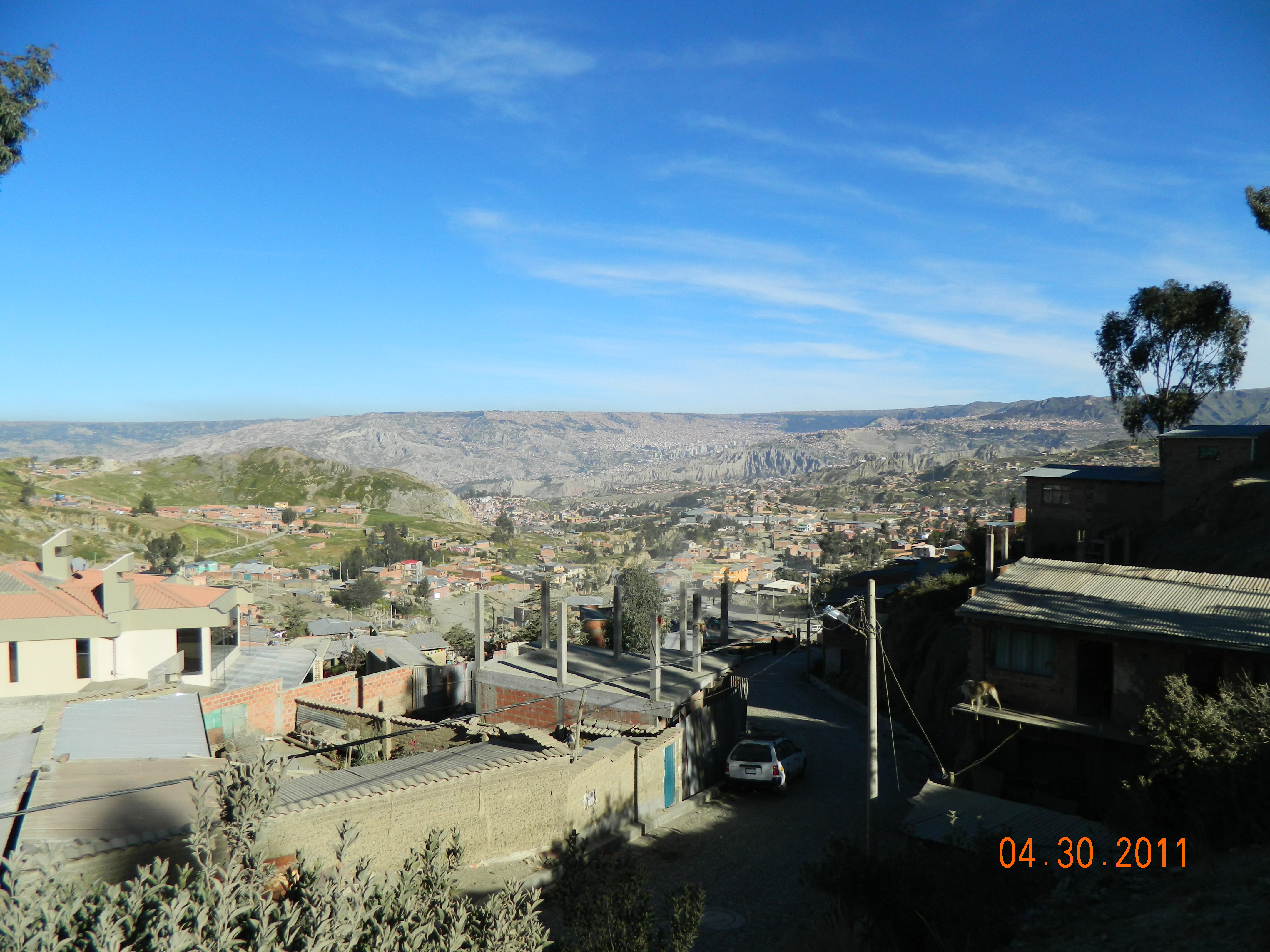
When I looked out the window this morning, I found a beautiful day awaiting me. The view above is looking north across La Paz, Bolivia, from the window of our home in the Serranias de Calacoto section of the city. With my spouse in the States for a family wedding and my teenage daughter unlikely to stir until late morning because, well, she’s a teenager, I decided to take a leisurely Sunday drive. After loading the high performance jack and a couple cold bottles of Coke Zero into the Jeep and plugging my iPod into the auxiliary port, I headed south, climbing out of the bowl that surrounds La Paz. The roads were near empty on this early Sunday morning, making for a wonderful, stressless departure.
(Please be sure and click on these photos; they look a gazillion times better and have much more clarity up close. Also, please ignore the dates stamped on them as I obviously fail when it comes to managing camera settings. All these photos were taken on Sunday, 29 April 2012.)
 The above is the view back towards La Paz as I neared the “cumbre” or high point of the valley just above the Apaña neighborhood of La Paz. This is only about 4-5 miles above our house, albeit an uphill climb all the way. From our house which sits at about 13,200 feet above sea level, you climb here to about 14,500 feet before crossing beyond the southern peaks and losing sight of the city. La Paz hosts about 1 million inhabitants. This photo gives you a bit of a sense of the expanse of La Paz but what it doesn’t show are the myriad valleys and canyons that cut through the landscape in all directions, each with its own unique, and always spectacular, landscapes and views. The city of El Alto – the fastest growing city in all of Bolivia – sits on the high plain or “altiplano” directly above La Paz on the ridge at the back of this photo. While you can’t see it from La Paz or in this photo, just over that ridge are another 1 million folk spread out on a flat expanse that continues all the way to Lake Titicaca.
 Here we’re just on the other side of the peaks surrounding La Paz to the south. The view is looking back along the road coming out of the city, which sits behind those tall cliffs. If you click on the above photo to get the higher quality view, you can see how deep cracks have been eroded into the cliffs by the rains that pound La Paz from about November through March of each year.
 This is only about a kilometer beyond the previous photo but now we’ve got La Paz to our backs and are looking south toward snow-covered Illimani Peak. You can see dust clouds raised by a few vehicles that headed down the road in front of me. It hasn’t rained much for 3-4 weeks so car and truck tires kick up huge swaths of fine dust, and with the complete lack of wind today, the dust really lingers in the air. Today’s destination, the small village of Totora Pampa, sits just past and to the right of Illimani from the above perspective. For anyone googling, this is the Totora Pampa in La Paz Department vice the bigger, more well-known Totora Pampa located much further south in Bolivia’s Cochabamba Department.
 Quite a bit closer to Illimani now, we’re just entering into the area around the small village of Ventilla. The way the lighting turned out in this photo, it almost looks like Illimani is painted onto the back portion of the scene. The canvas-covered patch to the right of the house at the center is an open-air Sunday market where locals buy and sell mainly fresh vegetables. At the time this picture was snapped on the outgoing trip, the market was just barely getting set up, but by the time I came back through on the return leg it was packed to the gills.
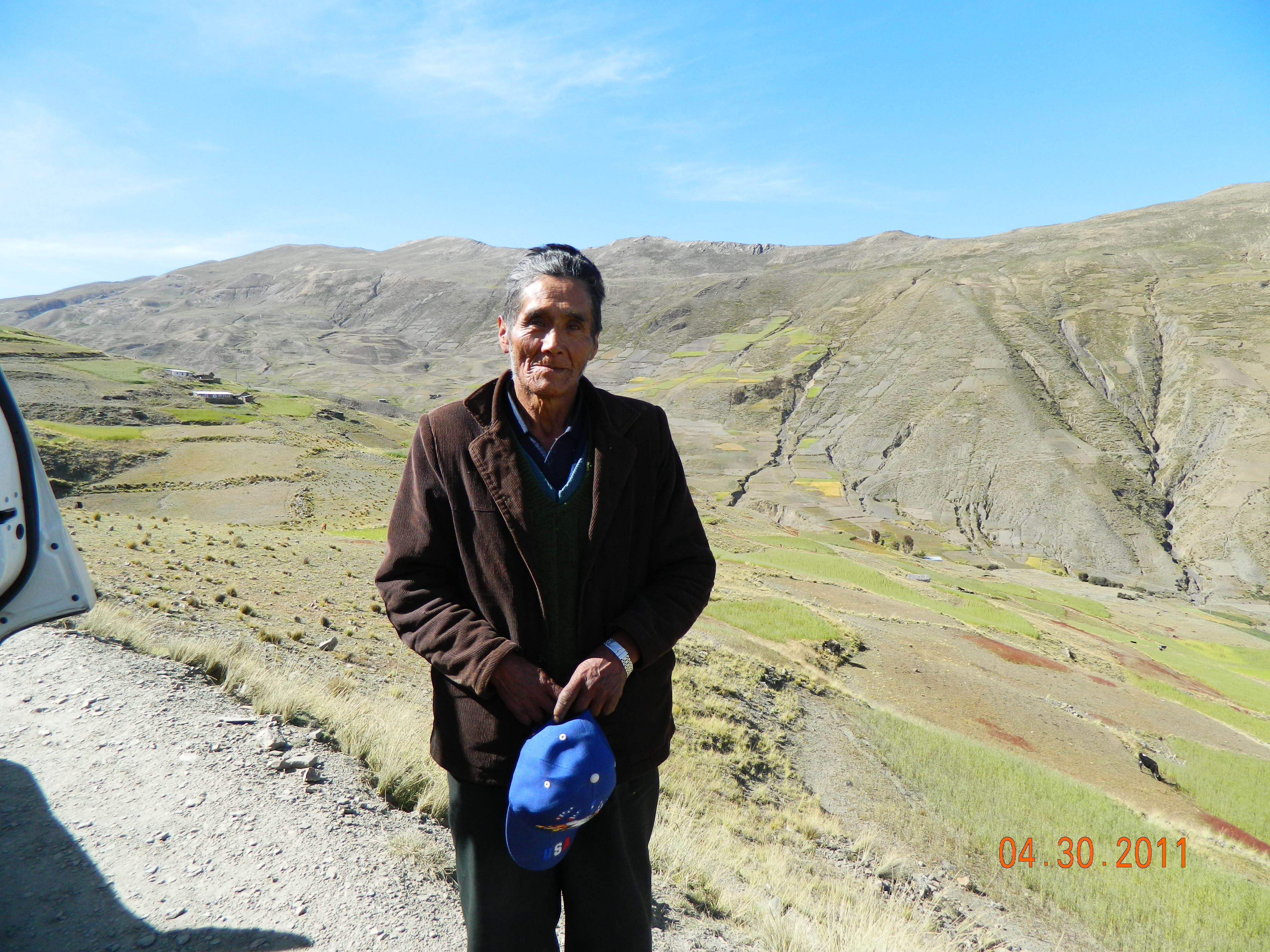 This fine gentleman waved me over just after I went around the bend above the market in the last photo and asked if I could give him a ride roughly four kilometers up the road to his home; I guess this is Bolivia’s version of a hitchhiker. He had walked down to the market to drop off some vegetables to sell. I talked to him as best I could on the drive up, but to be honest I could only make out about a third of what he said given his shortage of teeth. That said, he seemed to understand me well enough and was as pleasant a passenger as can be. He was kind enough to let me snap his picture as I dropped him off, in fact asking me to take a few and really getting a kick out of seeing how they turned on the camera’s viewscreen. If you look closely, you’ll see that the brim of his hat says “USA” in red, white and blue letters. His home was just off to the left of this photo, down a steep hill and past a tethered cow. As I shook his calloused hand in farewell, I felt immediately uncomfortable with the softness of my own candy-ass mitts. Damnit! Even if I have to spend an hour a day out in the yard just moving stones from one place to another and digging out weeds without a spade, I swear I’m going to toughen up these office-worker hands of mine.
 It’s been a pretty much continuous climb since leaving La Paz, but unfortunately I can’t provide an altitude estimate as I forgot to bring my GPS along for this trip. The snow-covered peak in this shot is the right-most (west?) side of Illimani. I know that somewhere along here there is a hiking trail that heads right up to the peak. Folks I know that have done it claim that it is not too tough, although at this altitude I’m not convinced.
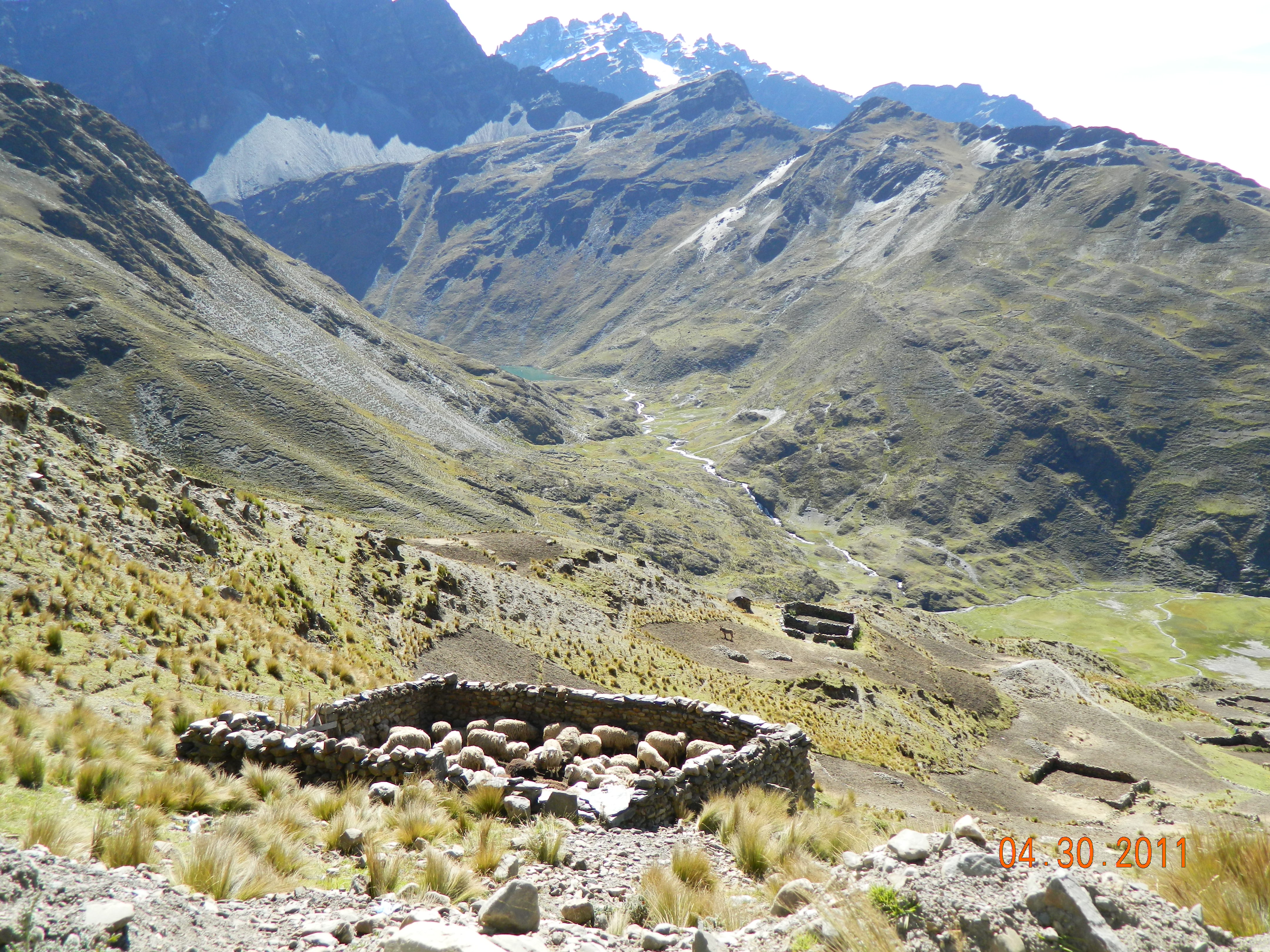 We’ve reached the outskirts of Totora Pampa, that is if tiny villages can have outskirts. The stone corral was packed tight with sheep, probably to be let out to graze later in the day. Right behind the corral, you can see a small lagoon with a stream running out of it down into the valley. This photo does not do it justice; it was a spectacular dark green color and looked crystal clear and teeth-chatteringly cold.
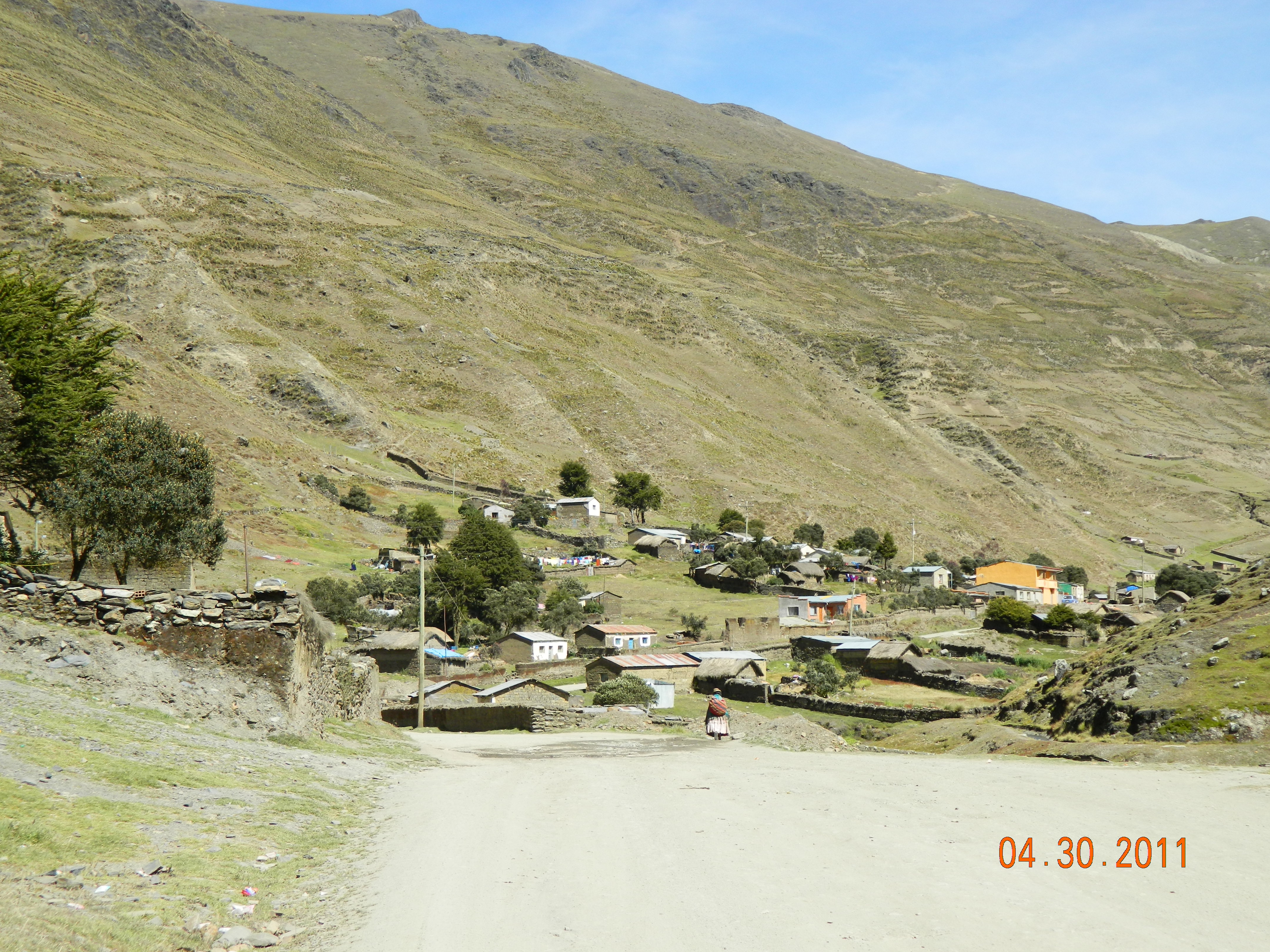
 Ok, we’re now past Illimani and entering Totora Pampa. This photo shows pretty much the entire extent of the town, although it does continue a little beyond the bend. To be honest, I didn’t know Totora Pampa was to be my destination when I left the house this morning. In fact, I didn’t even know Totora Pampa existed. It was roughly a three-hour drive here from La Paz at a leisurely pace, and stopping for photos along the way. The odometer showed it to only a 35-mile trek.
 This is looking back at Totora Pampa after having driven through and just around that bend at the back of the previous photo. While I know life is probably pretty damn hard for these folk, who are dedicated to small-scale agriculture and animal husbandry, I always find it hard when visiting such places not to be envious of the apparent tranquility and nearness to nature. As long as I could have all my modern amenities, like a giant stereo, super-speed internet, and 500 channels, this might be a place in which I could retire (smile).
 This photo is looking immediately to the right from the same place the previous picture was snapped. Those are mainly llamas, with a few alpacas interspersed among them. There’s a small stream with crystal clear water between me and them, which you’ll get a less-than-spectacular glimpse of in the next snap.
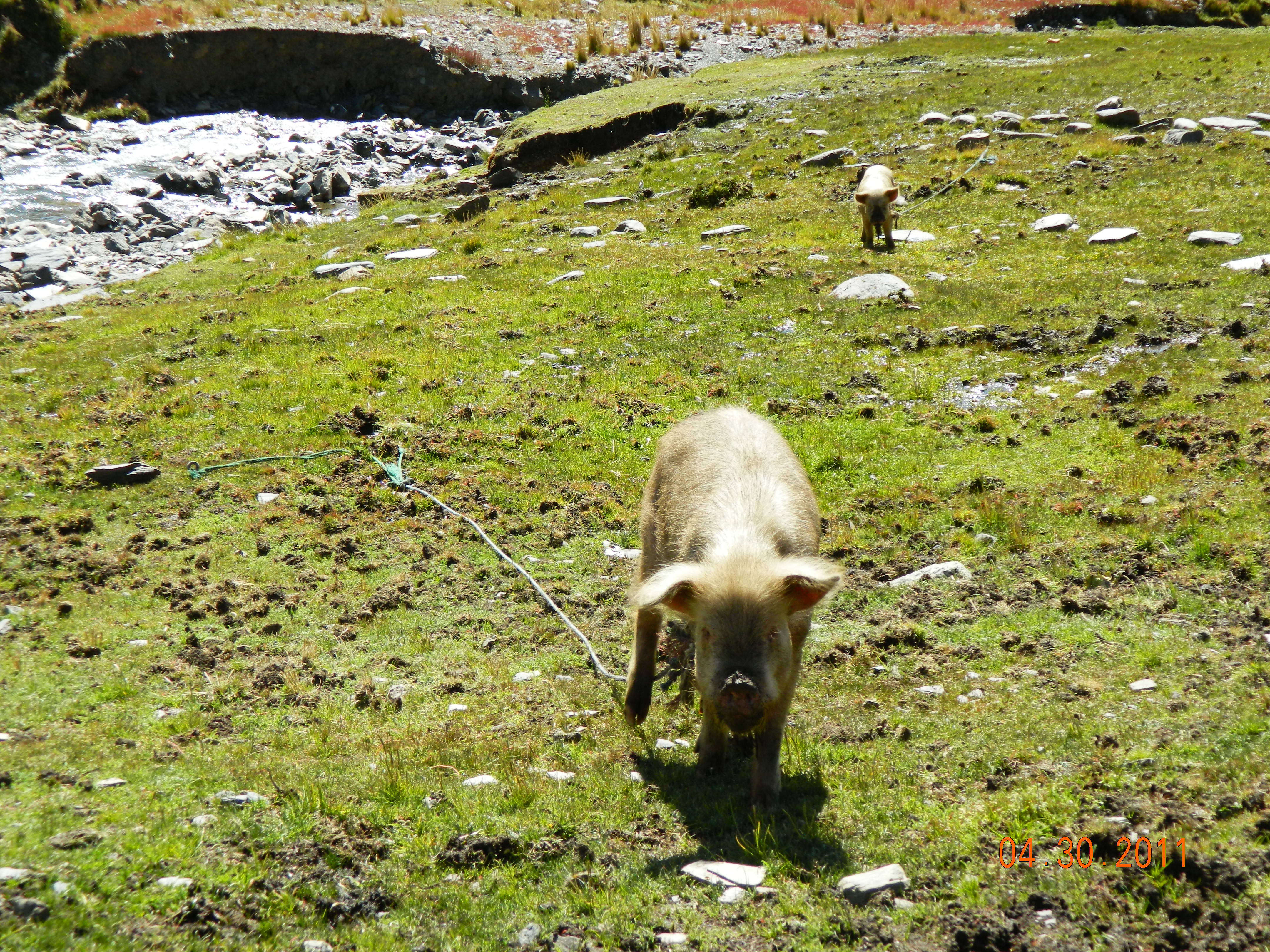 I walked down toward the stream from where I’d been taking the previous couple of shots in order to spend some time with these two friendly pigs. You can’t tell from the photo but the ground is muddy and marshy here and the tethered pair were using their snouts to dig down into it for grubs and roots, at least that’s what they were doing until I came along to demand their attention.
 I took this photo looking back toward the road from the same vantage point alongside my pork-bellied friends. Above the Jeep, you can see the ages-old terraces going all the way up what is a very steep hillside. They’ve been planting and harvesting around here using these methods to extend the arable land and better capture and hold water for centuries. The white lines that look like imperfections crossing the photo just above the Jeep are power lines. I decided to turn around and head back from here based on my calculation that I’d be able to make it back home in time to watch my beloved Utah Jazz take on the number-one seeded San Antonio Spurs in the first round of the NBA playoffs. I made it home in time, but the Jazz got smoked.
 Passing back through Totora Pampa to begin my return trip, I decided to pull over and photograph what looked to be an ongoing community meeting, with the men all sitting on wooden chairs and benches and the ladies spread out on the steps of the village school’s cement basketball/soccer pad. I tried hard not to bother the folks but if you click to get the close-up you’ll see all the ladies on the bottom row of the steps usings their mantas and hats to cover their faces against my unwanted intrusion into their affairs. A close view of the sign shows that Totora Pampa sits at 3,957 meters above sea level (up to you to convert to feet) and belongs to the province of Sud Yungas in the Department of La Paz.
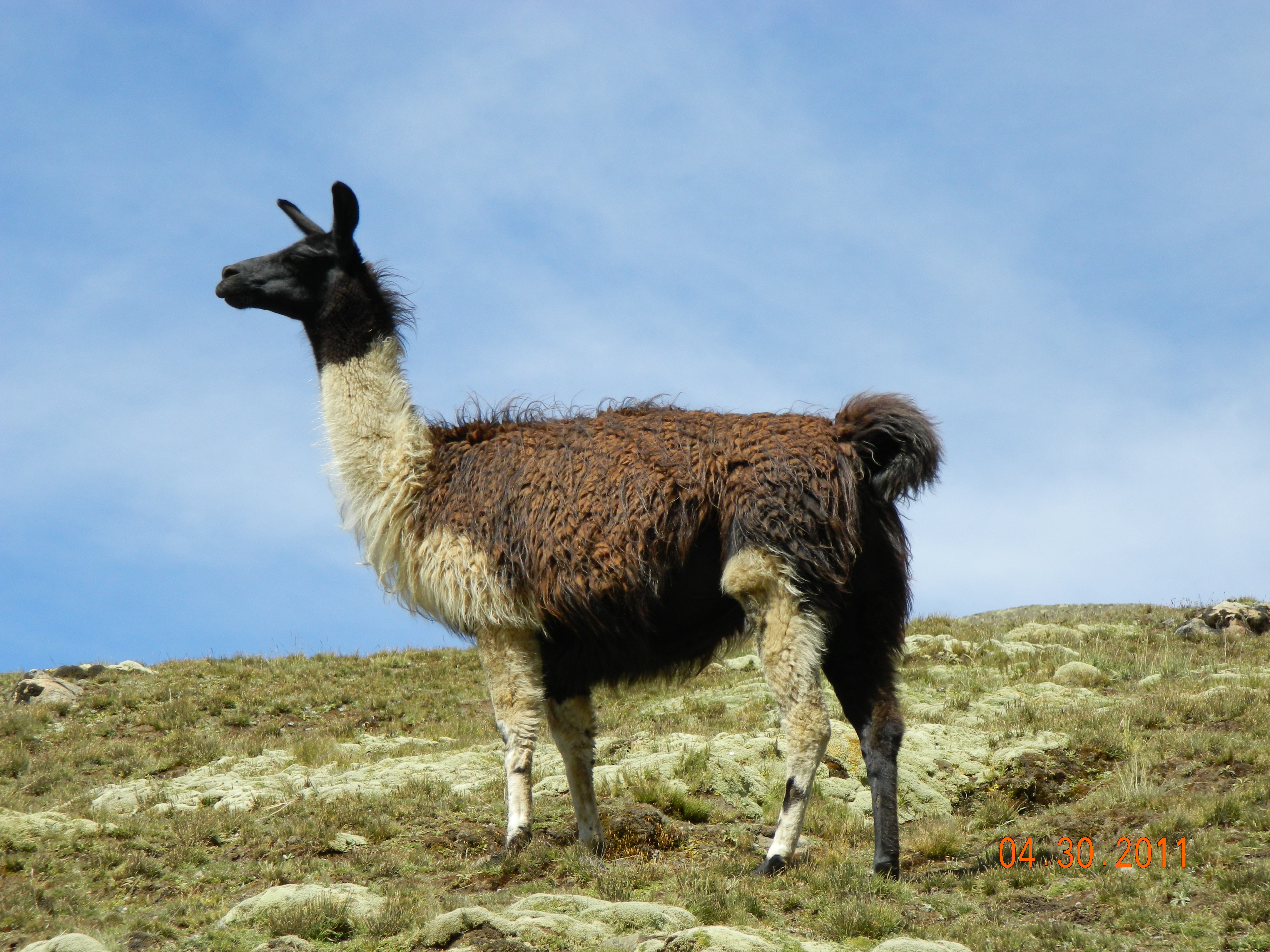 Of course, it wouldn’t be the Andes without plenty of opportunities to take pictures of grazing llamas. This guy belonged to the same herd I snapped earlier but had run out in front of me to cross to the other side of the road as I began to climb back up out of Totora Pampa. I yelled at him to try and get him to look at me but he didn’t care.
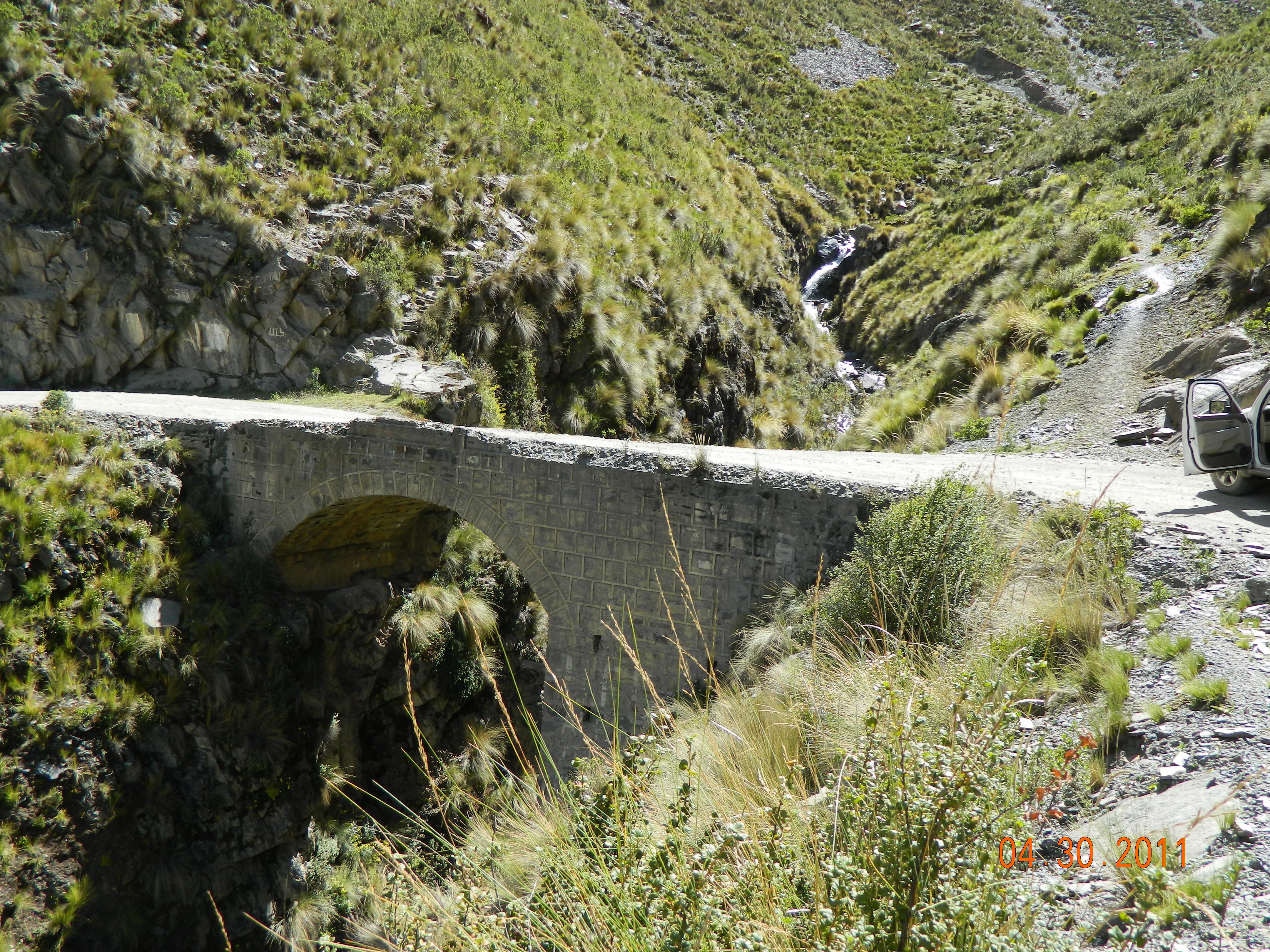 As I headed back toward La Paz, I stopped to get a photo of this neat cinderblock bridge over one of the pristine streams I passed as I traveled. One of the many cool things about being up this high is that there just aren’t that many people or animals above you to sully the waters before they make their way down to you. Yes, I did walk down to splash my face and drink from this icy cold stream. My assumption was that, with a good portion of the population of Totora Pampa involved in their community meeting, the parts per million of human excretions in the stream’s flow was likely pretty minimal at this moment.
 Here we are pointed back towards La Paz just past the above bridge. This ended up being the last photo I took today as just ahead I was waved over to pick up my second “hitchhikers” of the day. This time it was a young Andean mother and her four year-old son, Wilder, along with a fabric parcel full of just-harvested potatoes. I drove the pair all the way back to La Paz, a journey of about an hour, as they were headed to a family get-together where the fresh potatoes were to be roasted. Poor Wilder got car sick right away what with all the twists and turns, but Mommy had a plastic bag at the ready so the Jeep’s interior was saved. His stomach contents finally ejected, Wilder fell asleep for the rest of the ride. I enjoyed conversing with young Mommy greatly and opted to forego any more stops for pictures in order not to disturb Wilder’s post-puke sweet dreams. Wilder’s difficulties, coupled with the need to help Mommy load up her parcel, led me to opt against taking their photo as I dropped them off, a decision I now regret.
The 70-mile round trip was beyond wonderful, and has left me wondering why I don’t do this every weekend. This afternoon I’ve subsequently learned that just a few more miles beyond Totora Pampa is an area with primitive roadside restaurants where La Paz families occasionally head for grilled meats and potatoes and restorative relaxation under the Andean sky. Believe I’ll be loading up the family and heading back soon.
From the viewpoint of a dirty old man, Brazil is amazing. Female sexiness is rampant. Driving the streets, going into a grocery store, or visiting a public park, one can glimpse dozens upon dozens of the most beautiful women in the world, often dressed as provocatively as one could possibly hope. The pants are tight and low cut, many with the whole belt loop level sliced right off, leaving just the tattered “fraying” that made cut-off jeans so sexy back in the 1970s. Maybe 85-90 percent of the tops are belly shirts that, when coupled with the low-riding bottoms, mean that one can easily flirt with overdose on the volume of tight, flat abs and exposed hip bones.
Dark-skinned, light-skinned, blonde, brunette; they’re all everywhere, effusing sensuality 24-7. Looking to gape at a gorgeous hard body jogging in a sports bra and short shorts? No problem. Give me ten minutes to drive you around the town and we’re guaranteed five or six. Seeking to drool over a freely-exhibited female bellybutton piercing sported by a perfect 10? Piece of cake. I’ll have you within a few feet in no time and will throw in an extra 3-4 inches of taut exposed skin below the ring gratis. Interested in strolling behind barely-covered, all-over-tanned muscular goddess booty for 2-3 kilometers? Three blocks to the park and we’ll have you striding and staring in a heartbeat.
From the viewpoint of a father who believes that both the inner and outer beauty of his daughter is boundless, Brazil ain’t so hot. I rejoice in the expectation that my darling girl will turn heads throughout her life. I want my daughter to feel as pretty as I believe she is and will be always. But, I also want her to have no doubt that she can do whatever she wants with her life. I want her to never experience even a moment’s lack of confidence regarding her innate ability to make decisions for herself and choose her own path. I want her to be proud, self-confident, and independent. Yes, I want her to feel pretty, sexy, and fit, but I just as strongly want her to feel smart, fulfilled, and capable. I don’t want her to be pulled into a mentality that would convince that her value is based largely on how much male rubbernecking she can inspire.
From the viewpoint of a father of a boy on the verge of puberty, Brazil also gives me pause. I look forward to watching my son’s evolving discovery of girls. Thinking about the coming onset of his stuttering curiosity and eventual unlimited teenage horniness makes me smile. At the same time my boy gains an appreciation for hotties’ hotness however, I also want him to develop a respect for women as colleagues, friends, bosses and co-workers. I want him to see individual women in the most positive way as tough competitors for his job, counterpoints to his debate, and philosophers/leaders whose views he should consider before choosing his own path. I want him to be excited about actual sex (and the often even more thrilling “possibility” of sex) throughout his life, but I don’t want sex and sexiness to become like Lay’s Potato Chips for him. (“Hey, that was a damn good chip! I think I’ll just reach over and have another.”) No matter how many women my son “has relations” with in his lifetime, I hope it will always be a meaningful event for him. I don’t want him to view sex as he would a pick-up basketball game at the gym; fun, enjoyable and a good workout but still just one more pick-up game much like yesterday’s and tomorrow’s.
Yesterday, after I had returned from seeing Matrix Reloaded at the cinema with my son – and from having been unable, as usual, to not notice the hordes of drop-dead gorgeous, desirable Brazilian Eves oozing sensuality like sweat from their pores – my wife mentioned to me a conversation she had had earlier in the day with a Brasileira friend of hers. The friend, a mother of three preteens, was lamenting what she termed the promiscuity of the culture her kids were exposed to everyday. In her words, too many Brazilian girls learned to dress “sexy” from the time they were mere babies, a tendency we have experienced firsthand via our discomfort at some of the clothing our grade-school daughter has received as birthday presents from her Brazilian classmates. My wife’s friend went on to bemoan that, from her experience, even the word “flirting” in Brazilian Portuguese (paquerar) no longer was understood to suggest playfully alluring behavior but had come to imply doing the deed. She argued it wasn’t the word but the behaviors themselves that had evolved. Sex had become casual.
As I listened to my spouse share her friend’s concerns, my own first thought was quite honestly along the lines of “Damn, I wish I could have lived in Brazil when I was young and single.” However, my next thought was “Damn, that’s not what I want for my kids.”
Before deeming me a self-righteous prude, please note that it isn’t about being some chastity-demanding conservo-dad. It’s about not wanting sex to become routine and un-special for my children. And, damnit, it really is about discomfort with the objectification of women IN THEIR OWN MINDS, which is what I often sense in Brazil. (Note: No claim to be “enlightened” here – I’m simply the blessed father of a beautiful and amazing daughter.)
So, my final thoughts, in no particular order:
● A little bit of Puritanism is a good thing for a pubescent boy. Why? Because when he is then lucky enough to get that occasional coveted glimpse of bikini-clad girls at the beach, or that bend-over blouse front opening, or that Sports Illustrated bathing suit issue, it’s COOL and exciting, with the added thrill of naughtiness. It does not become routine.
● Upon becoming a woman, my daughter – and everybody’s daughter, for that matter – deserves to be both and concurrently respected for her brains and character as well as worshiped for her beauty.
● Sure, I want my son to be able to enjoy a slack-jawed, brain-freeze, blood-rush reaction to the Brazilian eye-candy smorgasbord should he be lucky enough to come back here later in life. In between the ogling however, I also want him to feel uncomfortable with a culture that seems to tell women that they exist to please men. I want him to not want his sister to be exposed to that culture.
● The thrill of Brazilian women’s deliberate sexiness and open sensuality cannot be fully appreciated by Brazilians, who take it for granted. Only lucky dudes visiting from more modest societies/upbringings can truly experience and enjoy the paradise of female exhibitionism that is Brazil.
● I’m glad to have experienced Brazilian sensuality firsthand; it is damn exhilarating. That said, I am gladder to be moving my preteen kids out of Brazil before they hit puberty.
– Brasilia, Brazil, May 2003

Last Kiss – J. Frank Wilson & the Cavaliers
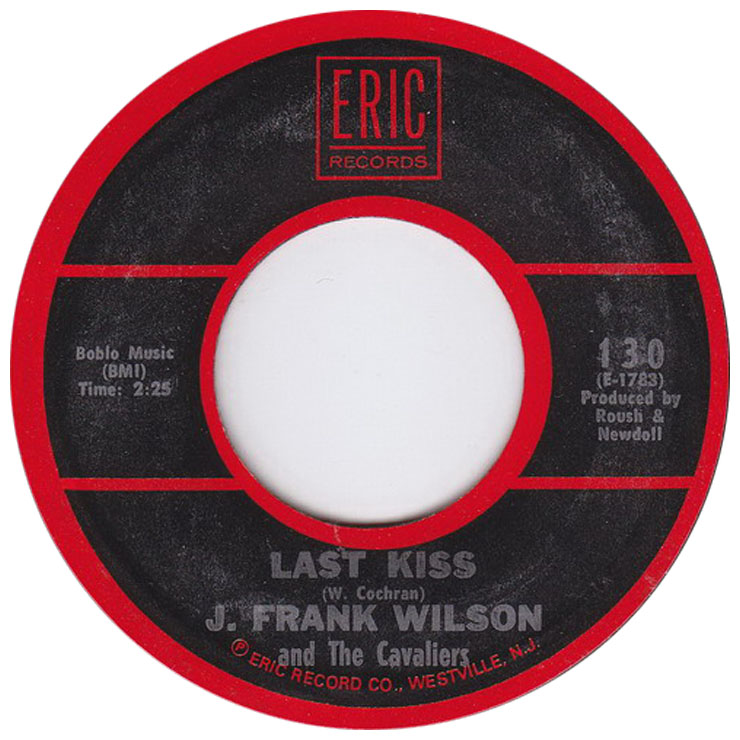
I couldn’t have been more than six-years-old when my best friend Brian’s older sister spun this song for us. Brian’s big sister was on the verge of puberty and so to us, anything she did was cool by definition. We listened to Salt Lake’s KCPX radio because she said it was way better than crappy KRSP or anything else on the AM dial. She knew stuff like that and so when she called us in the house telling us we just had to hear this song, we recognized it was a big deal. She played it twice, and we enthusiastically agreed that it was far out. I didn’t tell Brian or his sister that the song ended up giving me horrible nightmares.
The song tells the first-person story of a teenager out on a date with his high school love. As he drives along in his father’s car that he’s borrowed for the night, he suddenly comes upon a stalled vehicle in the middle of the road and has to swerve to avoid it, crashing violently in the process. He wakes up bloodied in the immediate aftermath of the accident, searching for and finding his girl. He cradles her head and gives her the titular “last kiss” as she dies. Alone following her death, he pledges to “be good” so that he can make it to heaven where the Lord has taken his true love so that he can be reunited with her upon his own passing.
While grown-up listeners might have thought it a tragic tale of true love, it was an outright horror story to my adolescent ears. I imagined the sounds of the “bustin’ glass” and the “painful scream” of the girl who was about to die, and quickly figured out that the “something warm” running in the eyes of the teen driver was scary blood, man. If the boy’s head was all bloody and he lived, what must the girl who died have looked like? I imagined the guy scooping up the girl’s terrifyingly mashed head. Were her guts hanging out? When he kissed her, was he putting his lips into mushy gore? The part about being good in order to get to heaven didn’t even register. All I could do was try to cast out the increasingly gooey mental picture of the mangled dead girl lying all unrecognizable on the pavement that was haunting my thoughts every time I went alone into my room at bedtime. It took a couple of weeks of leaving the light on before I finally forgot about that particular terror.
Hearing the song now, it’s nothing less than awesome. The walking bass line that is front and center throughout most of the song somehow manages to create a memorable groove without taking away from the tragedy in the lyric. The stand-alone drum fills that lead into and follow each verse are immediately recognizable and perfectly separate the progress of the story from the overarching chorus theme. The wordless backing vocals that accompany each verse seem to have been purposefully recorded in the red so that the resulting distortion gives them a sound like ominous wind warning of the terrible events to come. The falsetto backing vocal that accompanies all but the first instance of the chorus isn’t noticeable initially, but listening closely you realize it is that addition that makes the chorus sound more and more pleading and desperate each time it repeats. Nowadays, the dying girl in my mind picture is fully intact and beautiful; she passes due to internal injuries. Nightmare problem solved.
Last Kiss:
—————————————–
Billy, Don’t Be a Hero – Bo Donaldson & the Heywoods

I don’t recall much about 4th grade, but I do remember the day somebody brought in the single Billy, Don’t Be a Hero to play for the class. Our teacher, Mrs. Liechty, had a small record player in a corner of the classroom and would let kids play songs they wanted to share for show and tell. A female classmate brought in the record and put it on. I can’t remember how it was introduced but the whole class was enthralled right away. It was 1974 and Vietnam was still raging. While we were too young to pay much attention, we were aware of the war and saw the occasional news clip about soldiers fighting or heard our parents talk about it. We asked Mrs. Liechty to play the 45 over and over; I think she put it on four times over the course of the day.
The song tells over three verses how Billy goes off to war, leaving behind his fiancé who solely asked him to “not be a hero” in order to ensure his safe return to her arms. Billy ignores that instruction of course, volunteering to undertake a dangerous  mission to bring reinforcements to help his pinned-down unit. We don’t hear exactly what happens to Billy but we are told about the letter Billy’s fiancé later receives informing her of his heroic death, a letter which she throws away in grief to end the final verse.
By the time we were let out for recess, a bunch of us continued talking about the song, acting out gun battles while chanting the chorus and imagining what Billy’s valliant death was like. For a 10-year-old with a vague understanding that U.S. soldiers were dying in Vietnam, the story of a guy with a loving girl waiting for him at home who nonetheless volunteers for a super dangerous mission that gets him killed was high drama. The song’s implicit, unanswered question about whether Billy’s choosing to be a hero was a positive was a deep thing for a preteen mind to contemplate.
Listening now, the song actually seems pretty weird. For such a tragic story, it’s downright perky. Electric piano runs, tambourine, and poppy bass lines punctuate the chorus. The vocals sound relatively chipper even during the quieter, toned-down third verse in which we learn of Billy’s demise and his fiancé’s sad reaction to the news of his fatal heroism. The pair of references to Billy and his military colleagues as “soldier blues” seems unusual but fits well lyrically. One wonders who the narrator of the story might be as his relationship to Billy and his fiancé is not explained. He’s a bystander who recognizes the pair and is close enough to hear the fiancé’s farewell plea, but then only “hears about” the letter and the fiancé’s reaction to it. All said though, the tune is catchy as hell and that chorus is tough to excise once it drills its way into your inner soundtrack.
Billy, Don’t Be a Hero:
It’s movie-like. The view is from 18 floors up through a large, immaculately transparent sliding glass door that leads onto a private balcony. While two blocks from the beach, there are no buildings between here and there taller than ten stories. The vast panorama of blue ocean horizon is broken only by volcano peak islands about a mile out. Leblon beach – just down from more famous Copacabana and Ipanema – is full of sunbathers and beach volleyball and soccer enthusiasts.
Our protagonist sits facing the scene, downing cold liquids on the rocks and pounding out the prose that will later touch readers as if it had somehow cosmically connected with their souls, painting a word picture of their secret hopes, dreams, and despairs.
It’s not a movie though. Reality mimics the idealized vision but makes minor adjustments. Added is the musty smell of the US$60 per night, 1970s-style hotel room in which the action takes place. Also tacked on is a dull headache brought on by lack of sleep, a result of psychosomatic inability to find peace in a first-night hotel bed. Subtracted is the borderless and all-encompassing image, replaced by the grating light of a laptop screen filled with petulant carping and affected depth.
I’ll always be an outsider in Rio.
Sao Paulo is big, commercial, urban, same – reminiscent of almost any large metropolis. Surprises are uncommon. Grasping the flow of life requires no great effort. Walk the streets, browse the stores, buy some trinkets, relax your brain. No need to contemplate, no need to reason. It all makes sense.
Rio is other, the flow is alien. After facing the sensory blitzkrieg of tanned hardbody impossibabes intermingled with leather-skinned speedo freaks beachside, one is abruptly startled by piss-stink streets and Pythonesque open-wound beggars a few steps from the strand. You’re Carioca (of Rio) or you’re not. You fit in sui generis or you accept your manifest role as spectator apart.
Lose yourself, blend in, become gray and small, tune in, turn on, and drop out in Sao Paulo.
Feel its obliviousness to your presence and bear the excruciating knowledge of your own foreignness in Rio.
– Rio de Janeiro, June 2001


 Victim of the Fury