
I lie for a living. Ok, that’s not exactly right. I manipulate people and situations and facilitate the manipulation of people and situations by others in service of a greater good, and I get paid for it. Sometimes I question, albeit at a very shallow level, why I feel comfortable doing what I do. Usually, I either just stop thinking about it or I vaguely decide that the greater good makes it all ok. Other times, I wonder how, when, and why I developed the skills that have made me successful at my job. I have no answers but I do have some thoughts that I will share following this message from Henry Rollins:
Pinewood Derby: Next-door neighbors Dorothy and Harry were my pack leaders, guides, and mentors throughout my Cub Scout and Webelos career. I have great memories of pack meetings (with hot chocolate!), service projects (field clean-ups), talent shows (one five-note song on guitar), and cherry-picking outings. Harry especially worked hard to ensure we all had a positive, fun, and self-esteem-building experience in scouting.
As I look back, I realize that, for Harry, helping us develop self-confidence also meant protecting us (and possibly himself) from the pain of a poor showing. For example, I remember working hard on my first Pinewood Derby car. I carved a dragster-looking vehicle with a thin, long nose and a rounded rear end. I was especially proud of the metallic purple paint job and the little notched wind screen I formed right in front of where a driver would sit. In streamlining my car however, I had inadvertently whittled away much of the weight that would be needed to pull my racer down the Derby track at a respectable speed.
It turned out that many of my pack-mates had done the same thing, sacrificing well-distributed volume for increased cool. All was good though as Harry worked at some kind of machine or fabrication shop. He gathered up our cars and took them to work where he hollowed out carefully-selected holes that he then filled with lead and capped off with indiscernible wood plugs. Our cars came back appearing exactly the same, but with the added heft from the invisible modifications Harry suggested we not mention to our competitors from other Scout packs. Needless to say, our pack did exceptionally well in the district-wide competition. If I recall correctly, I think my purple dragster even won a couple of heats outright.
First Deer: I grew up hunting and fishing with my extended family and absolutely loved the annual late fall family trek to Ashley National Forest in northeastern Utah with uncles, aunts, and grandparents for the deer hunt. I spent many great times sitting on frosty cold ridges up above Sheep Creek at dawn with my mom, dad, step-dad, or grandpa waiting for mule deer to casually meander along or be pushed past us by other hunters making their way through the valley below. Later after the sun would rise a bit higher, we’d separate into our trucks and slowly ride along scrubby dirt roads looking for our prey.
Upon turning 16 and getting my own license, I was as excited as could be for my first trip to June’s Rock and vicinity as a full-fledged hunter. That was a sparse year for lawful bucks however, so our party was still skunked well into the first long weekend of the hunt. I felt pressure to at least get some shots off, having heard the story of my mom taking her first deer at age 14 and having witnessed and celebrated many successful hunts over the course of my childhood, so I was thrilled when Grandpa suggested he and I head out together one afternoon.
As we drove the rutted roads of what our family called the Death Valley area, Grandpa delighted me with endless stories of successful hunts from the preceding 50 years while we each scanned the trees on our side of the truck. I carried a .30-30 Winchester lever-action rifle that I imagined to be exactly the same as the one John Wayne shot heroically from horseback in the movie The Cowboys, while Grandpa cradled his bigger .30-06 bolt-action in his lap as he steered the pick-up around rocks and through ravines.
Maybe a half hour before sundown, we finally spotted a small two-point buck along the tree line on Grandpa’s side of the road. We jumped out of the vehicle and Grandpa impatiently urged (read: yelled at) me to shoot before the deer took off. I squeezed off two wild rounds that only served to spook the animal before Grandpa dropped it with one shot just as it was disappearing into the thick trees. We made quick work of bleeding and gutting the buck, with Grandpa dotingly guiding me as I undertook the bulk of the task.
As we dragged the carcass back to the pick-up, Grandpa matter-of-factly stated that I should take credit for the kill and before I knew it he was on the CB radio announcing that I had bagged my first deer and calling for our party to gather to head in for the evening. And just like that it was done. I was an accomplished hunter. A few weeks later, Mom presented me with the mounted antlers of “My First Deer” along with a plaque commemorating the milestone. To this day – or at least until this is read – family lore has me shooting that deer in 1980.
Missionary Work: My 18-month service as a Mormon missionary in Peru from 1983-1985 was easily the single most significant experience of my life in terms of influencing the course of what came after. It bequeathed me a foreign language, gave me a deep appreciation for and curiosity about other cultures and customs, taught me independence, and tweaked my interest in international politics to the point that it became first my course of study and later my career. The missionary experience showed me that I could sincerely care about and love other people, even strangers, in a profound and selfless way that I wouldn’t have imagined beforehand. Furthermore, my mission directly influenced who I would marry and explains why my children are wonderfully bilingual.
Above said, it bears remembering that I was only 19-20 years old at the time. I honestly believed (and still do) that I had an important message to share that could bring real happiness and comfort to many who chose to listen. But, how does an inexperienced teenage punk convince more worldly and entangled adults that they should consider upending their lives to do what he suggests?
The answer was surprising simple. First, the punk stops thinking about the difficulty of the task and just goes for it, walling off personal doubts and insecurities and opening himself to a purely emotional approach. “I can’t fully explain in rational terms why you should do this, I simply know beyond a shadow of a doubt that you should and that it will be a good thing for you.” As time goes on and the emotional approach becomes more “habitual,” the punk starts to notice that certain means of expressing words and feelings seem to touch the recipients more intensely, and therefore the punk actively tends toward greater use of those means.
Eventually, greater and greater experience leads to the employment of a kind of exquisitely-honed, albeit significantly more rote, oratory; the punk steps aside and the skilled missionary takes his place. Cynical and manipulative, you say? Not necessarily. As long as the missionary still believes sincerely and deeply that he is truly offering manna from heaven, then he is simply applying learned skills to more effectively achieve wonderful and blessed results. The greater good is served. Of course, there can be little doubt that such talents developed in pursuit of God’s glory can prove quite handy when applied toward less celestial goals later in life.
Conclusion: In the end, it is likely best to not spend too much time in further contemplation and instead just keep on producing positive results, allowing myself pride in my accomplishments, and banking them paychecks. Being expected to exercise strong and unfaltering personal integrity in leveraging manipulative skills and lies in service of the clear-cut greater good, where’s the problem? My personal favorite “alternative country” artist, Robbie Fulks, certainly gets it …
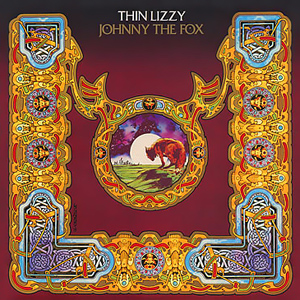
When I picked the 8-track cartridge out of the thrift store bin circa 1980, I honestly thought the name of the band was a sly  reference to a lean lesbian. It made buying the album feel like a rebellious act, especially since the thrift store was Deseret Industries in Ogden, Utah, which was run as a not-for-profit business by the Mormon Church. I imagined the nice lady who rang me up secretly harboring disdain for this punk kid who had made such an obviously inappropriate choice. Only much later did I learn that the moniker Thin Lizzy had nothing at all to do with hot, women-loving women but was rather a play on the nickname for the old Ford Model T, “Tin Lizzie.”
That then-four-year-old, used 8-track was Thin Lizzy’s seventh album, “Johnny the Fox.” I vaguely knew the band from hearing on the radio their big hit song from 1976 called “The Boys Are Back in Town,” with its groovy bass line and super catchy chorus, but I couldn’t have told you much about their background, style, or anything else. As far as I could tell, Thin Lizzy wasn’t popular with any of my friends or with anyone at all in my slice of the mountainwest. Nevertheless, at just 63 cents and with that cool, busy cover art showing a wolf seemingly stalking the full moon, I couldn’t see much risk in snapping up the album. (A 2012 epiphany: That’s possibly not a wolf on the cover but rather a fox given the name of the album. How the hell can I have only thought of this now?)
I didn’t listen to the tape immediately once I got it home. In fact, it sat unplayed for months. Thin Lizzy meant little to me and I didn’t recognize any of the song names on the label. Besides, it was a freaking 8-track and thus stood isolated from my greater, mainly vinyl music collection.
When I finally did decide to listen to the album, probably out of boredom, I was surprised at how good it was. Sitting there in the living room of my childhood home blasting the music out of my parents’ stereo system, I first noticed how uniquely forward in the mix the bass guitar sounded and was immediately won over by the “story song” nature of the first track, “Johnny.” Apparently drug-addled Johnny was on the run after having killed somebody and might just have to do it again. I was (and remain still) a sucker for story songs.
The second track, “Rocky,” introduced me to Thin Lizzy’s twin lead guitar set up and I was blown away. I was all about four-piece hard rock bands but was mired in the belief that one of the guitar players was “lead” and the other was rhythm, period. Hearing those dual guitar solos in which both virtuosos played the notes in unison followed by stretches where each unleashed separate but perfectly simpatico overlapping leads rocked my world. Continuing on, I was swept up by a series of slower, grooving ballads with searing, evocative guitar lines and lyrics about gutter bums, apologetic lovers, and famine victims – one song even had a spoken-word intro(!).
And then, oh my goodness…
The finishing stroke, coup de grâce, pièce de résistance that was the song “Massacre” hit me like a hammer. It had everything; a sort of marching-into-battle intro, soaring guitar lines that sounded like some sort of hard rock national anthem or rockin’ funeral dirge, and lyrics about 600 vaguely-identified soldier heroes doomed to overwhelming defeat and unceremonious death in some arid, sand-swept land. Rhyming “bandolero” with “doesn’t care though” still seems to me to be poetic genius even 32 years later and I continue to mentally strive to picture the “point below zero where the sun can see the land.” (What is this magnificent, mumbo-jumbo place that I know must exist somewhere, somehow? Do I need chemical enlightenment to travel there?) After hearing “Massacre” for the first time, I knew that no matter what future path my life took, I would irrevocably be, from that day forward, a Thin Lizzy disciple.
While it got regular listens during those initial post-purchase years whenever I had the house to myself and could bogart the folks’ stereo, “Johnny the Fox” eventually faded away in the mid-80s along with all its brother 8-tracks as the endless, unfeeling march of technological advance left them in its wake. As Mormon mission, college, marriage and career intervened to muddle my priorities, I never managed to replace the album on vinyl.
It finally took Metallica’s cover of previously-unknown-to-me Thin Lizzy song “Whiskey in the Jar” on their 1998 Garage Inc. album to snap me out of my stupor and remind me of my partisan responsibilities. I ordered “Johnny the Fox” on CD and have not strayed from the path since. I’ve broadened my Lizzy awareness, to include buying just now in 2012 the band’s first two, quite distinct but nonetheless outstanding, albums from 1971 and 1972. However, “Johnny the Fox” remains my unchallenged Thin Lizzy touchstone.
Thin Lizzy’s bass-playing black Irish vocalist, principal songwriter, and frontman Phil Lynott died in 1986 from pneumonia and heart failure brought on by years of alcohol and drug dependency. Over the band’s 13 active years of studio work from 1970-1983 various electrifying lead guitarists lent their talents to the Thin Lizzy legacy, to include the “classic” mid-to-late 70s dual attack of Scott Gorham and Brian Robertson and the in-again/out-again participation of the recently-passed Gary Moore, which reached its zenith on 1979’s “Black Rose” album. Despite the line-up changes, Lynott’s unique, emotion-filled voice and the group’s hard-rock-with-a-groove-laden-heart essence always remained. I personally wouldn’t throw any of their output aside.
A band called Thin Lizzy featuring long-time guitarist Gorham and all-but-permanent drummer Brian Downey continues to tour as I write. My right-thinking son saw them open for Judas Priest in Utah in October 2011 and had no complaints at all, albeit recognizing the unavoidable reality of their semi-tribute band status. While others may judge, I count the fact that my 90s-birthed boy can sing along to the entirety of “Massacre” among my greatest fatherly achievements. Motörhead mainman and unapologetic Thin Lizzy fan Lemmy Kilmeister often pulls out the Lizzy tune “Rosalie” in concert and seeing the ‘head perform the song live during a 2007 show in Caracas continues to be a cherished head-banging memory.
Thank heavens for thrift stores and misleading band names!
Work-wise, San Francisco 2002 looks like it will meet all expectations and then some. Needy folk are satisfactorily appeased, at least for the moment. Shopping lists have been accomplished. Taxpayer money has been spent vigorously and in a subjectively productive manner, but…
Damnit! This is not how I want the rest of my life to be. Do I care because I care or because I am paid to care? At times, I am unsure whether even I can tell the difference. Am I really interested in the story being told or is my lie so often repeated that it precludes recognition of the truth? Does it matter? It is not a moral qualm. Instead (and indeed), it is a questioning of myself precisely because of the lack of moral qualm. I want to contemplate the question no more forever.
Today is my 38th birthday (and George Washington’s 270th).
I crossed the Golden Gate Bridge and shortly thereafter abandoned Highway 101 for a two-laner through San Anselmo, Ross, and so on to Petaluma. The route took me through the Samuel Taylor National Park. Beauty abounded, as did soaring vultures (redundant, I know). The trees were often surprisingly close to the road, which lacked the drainage ditches and/or CCC-built rock walls to which I am accustomed from driving similar winding canyon roads in Utah.
At the truck stop just before the return to 101 I was mistaken for a trucker by the friendly Marge behind the counter, probably due to the baseball cap and a pathetic – even scraggly – ongoing facial hair experiment. I rolled with the flow, agreeing with Marge’s observation that a weekend ain’t all that different from the rest of the week for we long-haulers.
My wife loves me and wants me to be happy.
I don’t want to be evaluated, although I’m not sure exactly why given that I am generally assessed quite positively. I suspect it is the “idea” of the evaluation that bothers me vice the evaluation itself. I don’t want to have to think about the evaluation; don’t want to have to acknowledge that others will forever measure my worth. Fear of being judged unfavorably by others often leads me to unfavorably judge myself. Even in the face of positive feedback, I find myself convinced that I am undeserving of the happy appraisal and expecting that it is only a matter of time before my true weaknesses are discovered and my evaluations become more firmly based in reality (i.e more negative).
During occasional flashes of clarity, I realize that this thinking is misguided. It can’t all be smoke and mirrors; there has to be some merit to the positive reviews. While I personally know that I could do more and do better, I should not let that cloud in my own mind the fact that what I do do (doodoo?) is often pretty darn good. Unfortunately, these moments of right-thinking seem to be the exception, vice the rule.
My boy misses me and wants me to know that he got 100 on his math test this week.
Returning south on 101 I spied and subsequently patronized CompUSA. The two resulting purchases revolved around personal goals/hopes. I picked up an analog video capture card and editing software for the home PC that promises to help me translate all the old videos of weddings, babies, and growing, beautiful children into digital, DVD-player-ready VideoCDs. Witnessing the deterioration of picture and sound quality of videos filmed of my eldest way back when his having feet the size of his father’s seemed unimaginable has spurred a desire to take advantage of new technology to save the past, mainly for myself but also for posterity. The second item, an impulse buy, was a Guitar Instructional CD-ROM (endorsed by Peter Frampton!) that I hoped would get me off my duff and on my way to unleashing the six-string virtuosity I’ve always fantasized was within me. (I never should have entered the store hungry.)
My daughter wishes I was there to give her a hug and hopes I can bring her a certain Disney video.
I should have been a long-haul trucker. It is ironic that the personal trait that probably brings me the most stress and unnecessary angst is also that which most assuredly brings me the deepest, if fleeting, moments of unadulterated happiness. I am, of course, referring to my never waning thinker – that perpetual chemical reactor in my head that causes me to fret endlessly about who I am, what “it” means, and wither all hell… but which also occasionally allows me to obtain an indescribable level of profound serenity and sense of “Spirit.”
Unfortunately, the moments of stress-free enlightenment come irregularly and any attempt to delve too deeply to suss out patterns to explain them simply plunges me back into a buzzkill doomfest of self-questioning and doubt. Nevertheless, what can be safely confirmed is that long distance road trips and the experiences associated with them consistently take me to that higher plane. I really should have been a trucker.
My beloved Grandfather, for whom I named my firstborn, passed away yesterday.
– North from San Francisco, February 2002

Faith is a capricious creature, bounding from steadfast and soothing to unreliable and inadequate in the blink of an eye.
My fickle faith deserted me abruptly and unexpectedly one morning in early 1985 as I completed the final months of my service as a Mormon missionary in Peru. It happened while I was doing a 90-day stint as a “financial secretary” at the mission office in Lima. Living in a rented room in the home of an Argentine widow roughly two kilometers from the mission office, my Peruvian companion and I – Mormon missionaries always function in pairs known as “companionships” – hoofed it in to work every day. Our route had us crossing quiet streets and cutting through corner parks in San Isidro, one of the fanciest neighborhoods of Lima. It was usually a very pleasant walk.
On one morning seemingly no different than any other however, I glanced down at the base of a tree in the grassy median as we crossed Salaverry Avenue and noticed a featherless baby bird in the dirt weakly squawking. I looked up to see the nest from which the birdie must have fallen. It was about 15 feet up and on the lowest branch. I quickly recognized that, even if my companion were to lift me onto his shoulders, there would be no way to get anywhere near that nest, so I just kept walking. Between seeing the ill-fated bird, spotting the nest, and mentally calculating the futility of taking any action, maybe five seconds passed maximum.
I unexpectedly found myself spending the remaining kilometer plus of the trek pondering that baby bird. I became fixated on the question of why it had fallen, or more specifically why it had been “allowed” to fall. I knew that no one but me would ever see or otherwise be aware of that little newborn bird and its imminent, pointless death. Allowing my mental, missionary-grade certainty shield to sag ever so slightly, I even began wondering why God would allow that baby bird to die even though He could so easily float it right back into that nest without anyone being the wiser. Questions roiled my thoughts and my throat briefly shook with a few swallowed sobs as I walked two or three strides behind my oblivious companion. What possible purpose could the death of that innocent creature serve? Why would God work that way? As we silently arrived at the mission office door, I was deep in the midst of a foundation-threatening personal crisis of faith.

For better or worse, once inside the office, routine responsibilities intervened pretty quickly to pull me out of my funk. I was soon caught up in paying mission bills and calculating foreign exchange conversions and, before I realized it, the crisis had faded and was all but forgotten. The blessed mundane had interceded to save me from further gloom. I don’t remember thinking about the event again at all for some two years afterwards, or at least until…
One spring afternoon in 1987 after attending undergrad classes at Utah State University, I was walking through the student-filled neighborhoods of Logan, Utah, toward the apartment I shared with two buddies who had served as missionaries with me in Peru. I was only a few blocks from the apartment when I heard a commotion alongside the road and looked over to see a sparrow flapping wildly on the ground. I eased toward it and, seeing that it had a broken wing, decided almost without thinking to help it. I was able to snatch it up and nestle it in my arms easily, and proceeded to carry it the rest of the way home. Once there, I searched for and called the local Animal Control number, explaining I had an injured bird and asking what I should do. The nice lady took my address and said someone would be right there.
Sitting alone in the apartment waiting for Animal Control to come and save my swallow, I suddenly remembered the forgotten baby bird from two years prior. The memory of that previous emotional walk through San Isidro as a missionary flooded back into my thoughts.
I honestly cannot now recall the full details, but I know I experienced in that moment a sort of epiphany. I sensed some kind of connection between this sparrow and that doomed hatchling from my past. I felt that in some way saving this broken sparrow in 1987 transcended time to rescue 1985’s innocent as well. All my questions and doubts of two years earlier were resurrected in my thoughts one by one only to be immediately and profoundly washed away in a wave of understanding. By the time the Animal Control officer arrived and took the swallow off my hands, I was joyous. My faith was strong.

Following the sparrow’s departure, routine responsibilities intervened pretty quickly to pull me out of my rapture. I had soon forgotten whatever it was about the experience that had made me so happy. To this day, I am clueless about my specific thoughts at the time, but I tend to imagine that I must have achieved a kind of welcome liberation from the shackles of some deep, unconscious remorse over having ignored the pleading warbles of that condemned baby bird that day in 1985. As for the sparrow, I assume Animal Control probably wrung its neck and tossed it in the trash soon after taking it off my hands.
Faith is a capricious creature, slipping from convenient and simple to unneeded and forgotten in the blink of an eye.
I had often thought that there was something off about the “Shuffle Songs” feature on my iPod. Whether it was the way it appeared to settle on the first track of albums more often than deeper cuts or that some tune or another by The Runaways magically played each time I had my daughter in the car, there seemed to be a non-random intelligence behind the “chance” song selections. With over 22,000 songs uploaded, why was it that tracks by Cher came up more frequently than the laws of probability would support, and why so often when I just happened to have someone with me who might misunderstand how my Cher fandom really does fit in with my otherwise more He-Manly musical tastes? Something was definitely going on here.
 Every time I attempted to test my theory that my iPod’s shuffle feature was acting with a purpose, I found only futility. I repeatedly made the effort to monitor album track selections over short intervals, only to find myself drowned in Track 2s, 5s, and even 14s, with barely a Track 1 in the mix.
But lo and behold, it never failed that within a few days of giving up the investigation, I would find myself shaken out of an absentminded listening session by the realization that I had just heard two Track 1s in a row, and further plagued by a sense that, in the face of my inattentiveness, I had once again been disproportionately deluged with album-opening tracks. “Shuffle Songs” was playing with me; like Schrödinger’s cat, it was alive and manipulating right up until the moment I actually sought to open the box.
To my surprise however, something changed the other day on the way to work. Either “Shuffle Songs” got cocky and carelessly brought its usually subliminal core consciousness too near the surface or it overstepped in a delicate attempt to insinuate a cosmic message into my thoughts. Within a three-song series, I “randomly” found myself hearing “God Isn’t Real” by Robbie Fulks and “Satan Is Real” by the Louvin Brothers.
Whether anti-religious agitation, diabolic proselytizing, or just good old fashioned taking the piss, the implication was clear: chance had been damned and a sentient will had been revealed. “Shuffle Songs” made a ham-handed attempt to mask its purposeful act by flailing erratically from the aggression of Pantera to the dulcet tones of Dolly Parton over the remaining course of my drive, but it was too little too late.
As to whether this message transmitted by the “Shuffle Songs” consciousness was meant as a cautionary observation on the proliferation of evil in the world or an outright vote in favor of Satanism, I cannot say. But even if simply mischievous playfulness by a nascent and still-immature life form, one can’t help but wonder what the evolution of this new vita ex machina will mean for the future of humankind. Also, what’s the deal with its weird fetish for Track 1s?


 Victim of the Fury