
OLD PHOTOGRAPHS
——————
She looks so strong;
still black hair tightly braided
bundled uncle on her back
stern confidence in black and white.
—
She looks so wise;
truths by firelight revealed
ageless wisdom of the elder
questions answered in fading eyes.
—
She looks so frail;
now grayed hair by others brushed
uncle’s passing on her face
passion displaced by cheerless faith.
—
She looks so unsure;
gospel burdens discharge the day
ancient stories for curious ears
realities hidden in weakness’ name.
—
She is so beautiful;
calloused touch to quell all doubts
practiced love to steer the soul
yellowed portrait of magnificent life.
— College Station, Texas, 1991
———————
I came across the above tonight while shuffling through some old files. It was my first and only attempt ever to write a poem. It was crafted one afternoon in my graduate student office in the economics department at Texas A&M University shortly after learning that my wife’s uncle, the youngest son of my very special grandmother-in-law, had passed away unexpectedly of a heart attack while working at a mine in central Peru. I can’t recall much about my mindset at the time but I imagine I was thinking about the wonderfulness of grandmothers and the sadness of seeing them suffer.
I note with some dismay that my creative tendencies back then appear to have leaned strongly toward sentimental pap, much as they regrettably still do today. I’ve clearly got to put together that post I have been meaning to do on the glories of satanic rock post haste.
In the meantime, it’s the thought that counts and, with that in mind, the spirit of this post goes out to my four beautiful grandmothers, all of whom bore the pain of the untimely loss of their baby boys:
– Grandma Madge, who lost youngest son Val, aged 23, to a road accident in 1982.
– Grandma Z, who lost youngest son Bob, aged 45, to a diving accident in 1989.
– Abuelita Tani, who lost youngest son Pancho, aged 40, to a heart attack in 1991.
– Grandma Ardelle, who lost youngest son Terry, aged 45, to a heart attack in 1992.
I recently had the unexpected pleasure to attend an Extreme Metal music festival in the city of El Alto, located on the high plains above La Paz, Bolivia. (See the poster for the unfortunately-named event below.) Over the course of eight hours, my friends and I saw eight Bolivian bands whose music ranged from the melodic metal to which I am personally most inclined, to the most dissonant of ear-torturing black metal, with intermediate stops at Celtic folk metal (including an electric violin and flute!) and Viking battle metal in between. To discover that Bolivia had a vibrant local metal scene, let alone one that boasted such a wide span of extreme styles, was a wonderful surprise.
As we banged our heads to the offerings of Obitus Designious, Purgatorium, Maldicion Kennedy, Belfast, Angaros, and others, we were repeatedly astounded at the talent of various players, gawking slack-jawed at the skills of a shredding guitarist here or a bludgeoning drummer there. Replicating my prior experience at concerts in La Paz by big-name bands from foreign lands, I found the Bolivian metalhead crowd to be as friendly and welcoming as could be. The small, open venue allowed us the added benefit of being able to meet and mingle with various smiling band members, all of whom were delighted to share with us their musical influences and a bit of their backgrounds. Most were students playing music on the side out of pure love for the craft. It was truly a good time.

Fast forward a few weeks and the performance that seems to have most deeply embedded itself in my memory is the one by a band whose style was the farthest possible from my usual comfort zone. While I routinely avoid the grunting/growling vocals that are the norm for many subgenres of extreme metal nowadays, I found the throat-ripping emissions discharged by the petite lead “singer” of the three-piece, all-female death metal band SAITA utterly riveting. While her two bandmates eked out a minimalist metallic march behind her on down-tuned electric guitar and drums, the denim-clad songstress expelled her vocals as if coughing them up from the bowels of some bottomless, lightless torture pit. Watching her contort her small frame – an accomplishment in itself given her tightest-I’ve-ever-seen jeans – to wrench out those hell-spawned sounds, I was rapt (and probably possessed). Wow, just wow.
Although I have no idea where the band got their name, SAITA appears to be a Japanese word meaning “blossoming,” as in Hana Saita or “blossoming flower.” I approached the girls after their set and found them to be of the sweetest, soft-hearted and least-intimidating sort one can imagine. They appeared genuinely flattered at my interest, delightedly explaining that this had been their first-ever performance and noting their availability if I knew of any future events they could play. It just goes to reinforce once again that one should never judge a book by its Hades-evoking cover.
Watch the video below that I taped during the show to experience for yourself SAITA’s dulcet tones. If you wonder from whence the likes of SAITA arise way up here in the Andean highlands, I can solely think to quote metal prophet Ozzy Osbourne in response, “Don’t ask me. I don’t know.”
The music leaking out of the study where my teenage daughter was ensconced seemed familiar but was initially too muted to identify. It certainly didn’t sound like the bass-heavy dance and pop hits that usually served as her go-to homework accompaniment. After a couple of minutes, I finally grasped what I was hearing. My 21st century child was listening to No Quarter, one of my all-time favorite songs by 20th century legends Led Zeppelin.
Fearing that the epic tune might have simply come up randomly in some sort of shuffle-all coincidence, I burst into the study to either ensure due attention and respect was being paid or to compel a skip forward to a more “background”-appropriate song. To my happy surprise, I found the fruit of my loins not only playing the song by choice, but singing along ardently. Professing love for the song and claiming its regular use as a nightcap to send her off to dreamland, she noted having first heard it in the car while riding with me a year or so before, copying it onto her iPad shortly thereafter. What a joy to learn that, without coercion or even conscious intent, my parental influence had spawned such a glorious result – my daughter asks No Quarter!
Sometimes a piece of music cannot be separated from the context in which it is initially heard, and that is definitely the case for me with No Quarter. The song will always send me back into the waking dream I first experienced in the dark, half-filled Egyptian Theater in Ogden, Utah, while watching a special midnight showing of the Led Zeppelin concert film, The Song Remains the Same, one weekend night in 1979. Perhaps influenced by the visuals interspersed within the film’s performance footage, No Quarter still conjures in me slow-motion visions of headless horsemen haunting the fog-filled night of some murky English countryside. From the gloomy keyboards, to the plodding drums, to the skulking guitar, the music seems molded to mesmerize. Add in doom-laden lyrics sung so as to evoke the impending loss of all hope, and you’re left with some of the most mood-altering music ever recorded. And now I get to share the mental trip with my own cherished daughter.
Who needs quaaludes when the winds of Thor blow this cold?
A year ago this past January, I came upon various obituaries written for Larry “Rhino” Reinhardt on the classic rock-themed websites I visit religiously. I’d never heard of him but was intrigued to read he was a one-time member of Iron Butterfly who later went on to cofound a psychedelic/progressive rock band in the 70s with original Deep Purple singer Rod Evans, whose vocals on the early Purple records I really like. I learned the band was called Captain Beyond and they had put out three albums (two with Evans) over the course of five years before splitting up. Always game to check out new old hard rock that I missed the first time around, I quickly got ahold of the albums, which turned out to be one of the few indisputably good decisions I made in 2012.
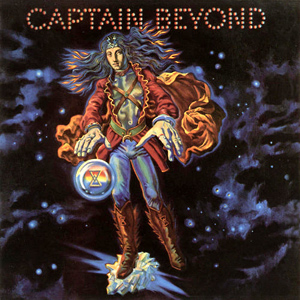

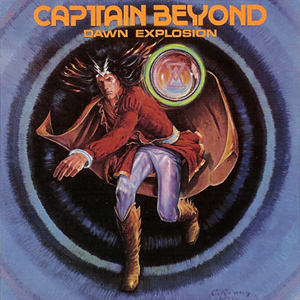
Captain Beyond’s music rocks, but not too hard, settling into cool, almost ethereal, passages in between frequent riff-laden heavier phases. The time signature changes and tempo shifts within songs and throughout album sequences remind me of the haughty progressiveness of the band Yes, but with the self-importance significantly toned down. In fact, while the tight musicianship rivals the most pretentious groups of the 70s, Captain Beyond shows no qualms about firmly anchoring even their most woozy explorations on strong groove-based foundations. Song lyrics are generally accessible, avoiding the opaque conceptualism of many progressive bands of the era, but still boasting a theatrical, spaceship earth “let’s all love each other” kind of theme.
Sealing the deal for me is the fact that Rhino’s lead guitar turns out to be wonderfully conspicuous in the least egotistical way. His playing is concurrently dominant and unselfish, never overwhelming the broader journey even when deservedly screaming for singular attention.
Upon his death, I’d guess Rhino could probably boast a million living people who either were currently or had been previously aware of his existence over the course of his 63 years. Of those, maybe 100,000 had any continuing sense of Rhino’s specific contribution to humanity after 1978 or so. Rhino does not appear to have died rich; although neither did he go out face down in a drug-addled gutter. I like to think he lived a contented life. I imagine him fully relishing his accomplishments, while harboring no internal tension or doubt occasioned by the fact that his broadest reach was 35 years behind him at the time of his passing. I’m vicariously happy for him in that, even though he is now gone, his legacy has been newly discovered and brings real joy to a brand-new friend, something it should continue to do for many years to come. I reckon that, as long as I keep enjoying his fruits, Rhino lives on.
And so it turns out a post-death presentation does not necessarily reduce the pleasure in making the acquaintance. My late but gratifying introduction to Rhino has me thinking: When I’m gone, will a new friend ever be pleased to meet me? Will discovery of my contribution ever brighten some future inquirer’s day? Is it healthy to care? Answering such questions sounds like a job for Captain Beyond …

While working in Caracas from 2006-2009, I would regularly tune in whenever Venezuelan President Hugo Chavez would address the nation, which he did constantly and usually for hours on end. I seldom paid close attention for more than 30 minutes or so as the actual content of his comments often either bored me to death with minutia or simply pissed me off. But even after drifting into other activities, I would leave the television on and let the voice of President Chavez serve as my background music; and I do mean music. I loved his voice and grew to find his cadence and tone soothing. His voice relaxed me.

Antonio Gramsci
One Saturday in early June of 2007, I was semi-listening to Chavez address a huge crowd of followers that had been called into the streets in demonstration of support for something that I no longer recall. My half-hearted awareness became rapt attention when I realized he was extensively quoting Antonio Gramsci, the early 20th century Italian writer, philosopher, and Marxist thinker. Chavez spent a full 40 minutes explaining Gramsci’s theory of revolutionary change in great detail to his flag-waving devotees. I kept wondering who other than breathless undergraduates even read Gramsci anymore, let alone attempted to impart to tens of thousands of gyrating sycophants the particulars of Gramsci’s missives on the growth of popular power via the establishment of a working class cultural hegemony.
As Chavez went on and on, the mass of red-shirted supporters in front of him jumped from cheer to cheer, seemingly oblivious to the lesson in political development theory they were receiving. They waved banners with pictures of Chavez, Simon Bolivar, Salvador Allende, and others and held their breath for each time the Comandante referred to himself in the third person so they could burst into a mass orgasm of applause and roars. I was engrossed.
Back in my college days when I was buying my own personal copies of Das Kapital and Mao’s Little Red Book and arriving early to hear visiting Sandinista ministers rail against imperialism, I had played at study of Gramsci. I learned enough to be impressed with my own efforts and even cited Gramsci in a paper I wrote which attempted to objectively and unemotionally describe the ideology of Peru’s Shining Path guerrillas separate from their bloodthirsty actions:
“Antonio Gramsci has also written about the need for a proletarian attitude. He stresses the importance of a revolutionary proletariat developing its own ‘superstructure’ prior to taking power. He argues that understanding of proletarian ideology does not appear from ‘haphazard and sporadic germination’ but through experience (Gramsci 1957, p. 187). Shining Path agrees with these arguments and sees the long period of democratic revolution as a time when the peasants and petty bourgeoisie will come to recognize Maoism as the ‘correct’ ideology.”
And now here was Chavez matter-of-factly offering up Gramsci’s complicated ideas to his generally lower economic strata and relatively less educated followers, literally Venezuela’s proletariat and peasant classes. Most remarkable was his seeming sincere belief that his masses deserved to be treated as being fully capable of comprehending the ideas he was illuminating.
Now that he’s gone, I’ll remember Hugo Chavez’s willingness to lie and cheat and divert blame to accomplish his goals. I’ll remember his anti-democratic actions and his systematic centralization of political power in his hands alone. I’ll remember his readiness to cynically manipulate people and information whenever it suited his political and ideological ends.
I’ll also remember him as a tireless advocate for the right of the poor, ignored, and uneducated to be heard and to exercise influence over those who govern them. Even more, I’ll remember his success in convincing those same marginalized folk to enthusiastically buy into his vision and to learn to act on it. As Venezuelans rightly begin to cast off the excesses and drastic inefficiencies of Chavismo in the course of these coming post-Chavez years, I hope they nonetheless retain the newly politicized underclass that Chavez engendered, an underclass capable of effectively asserting its weight and demanding the attention of political leaders.
I’m sorry to see you go this way, Comandante. You should have lost power through an eventual electoral defeat resulting from your own increasing missteps and political overreach, not due to this merciless disease. Your mistakes and conceit should have done you in, leaving you to bluster away into revolutionary oblivion while those who followed you in power selectively picked up and ran with your few, but substantial, achievements in political empowerment. Mostly, I’ll miss the calming effect of your voice in the background.



 Victim of the Fury