
Although I read them on near-daily basis, I’m not much for writing album reviews. Sometimes I tell stories in which a particular album plays a role and I will often offer up a personal view of the album within that context, but I tend to shy away from standalone reviews. This choice reflects an array of insecurities, to include the idea that my individual tastes are too personal to be of value to others, doubts about my ability to “hear” and subsequently describe in words distinct facets of musical compositions and arrangements in an informative way, and a sense that I tend to like everything and thus would fill pages with indistinguishable, thesaurus-heavy babble about how every album is “excellent” and “moving” and “rocks.”
There is no problem or lament here because the truth is that I don’t want to write album reviews. I am self-aware enough to recognize that I am self-absorbed enough that the main topic of most of my non-work-related writing is me. For whatever reason, I tend to view myself and my history through the prism of my music listening habits and fandom. Therefore, much of what I write revolves around music. I end up with what is basically a personal diary framed within a (written) musical soundtrack. This occasional creative outlet brings me joy and, in my mind, lends my internal life narrative a coveted epic nature that, for causes even I don’t understand, I am unable to embrace otherwise despite my wonderful family, world travels, enviable experiences, and interesting job.
All of this is prologue to my advising that I have recently come upon an excellent album that rocks in a unique way, and which has moved me to do something I seldom do, attempt to write an album review. The album is Ótta, released by the band Sólstafir in 2014. I purchased the CD after being enticed by descriptions and praise of it on some favorite blogs and album review sites. Sólstafir’s Icelandic origin was also a particular draw given that I recently lived vicariously through my son’s two-month unpaid internship there, which included a weeklong solo road trip through the island nation’s glorious landscapes. (Is it healthy to be happy for, but concurrently a little resentful of, one’s own child for being first to have an experience that one has always dreamed about for oneself?)
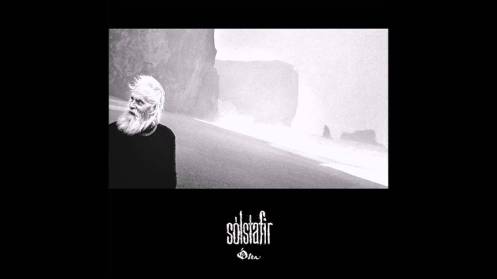
I have been listening to Ótta a lot since it arrived in the mail roughly a week ago. I’ve had it booming from the speakers while taking my new subcompact – a Honda Fit! – on its first highway drive, streaming from headphones in a darkened room as well as during a late-night winter’s walking of the dog through cold, empty northern Virginia streets, and playing in my study now as I type. Each time it has drawn me in, demanding my active attention despite being what I would describe as atmospheric. It is background music, but only for a foreground that it creates itself. I hear vastness, the sound of movement through the emptiness of space, but the vessel on which I travel isn’t some lonely metal container, it is Earth itself transporting me through the heavens. I feel concurrently lost in the infinite expanse of a cold universe and warmed in the embrace of nature, nature in which I myself form an integral part.
The songs are all sung in Icelandic and thus outwardly unintelligible to me. I have purposefully avoided seeking translations of song names or lyrics and do not know whether the album’s eight tracks are presented by the band as being of a piece or as a collection of individual, discrete offerings. I personally experience it as one cohesive work, the lack of literal understanding of the words allowing me to create my own mutable narrative at each listen. For all I know, it is in actuality a concept record about nomadic sheep-herding, but the overall theme in which I internally frame it is one of “heroic despair.” To me, it is the joyous sound of humankind’s billion-fold individual decisions to arise anew each day to meet fleeting, immediate challenges even in the face of inevitable existential doom. It’s cosmically terrible, and it is freaking beautiful.

Sólstafir the band, journeying through the vast cosmos aboard Spaceship Earth (photo lifted from metal-maniac.com)
While it is generally guitars that appeal to me, in this case it is Sólstafir’s blending of the sound of acoustic piano and classical strings into the mix that most moves me. Described variously online as pagan or heathen rock, “post metal,” and atmospheric progressive metal — among many other possibly made-up categories — Sólstafir exists within this new century’s wonderfully diverse and wide-ranging “metal” genre. Within that sphere, Ótta has made many critics’ lists of best “extreme” releases for 2014. The only thing extreme about this music however is its extreme beauty. My classical music loving uncle should listen to this. My piano jazz loving dad should listen to this. My epic power metal loving son and pop-leaning-but-eclectic daughter should listen to this. My long-suffering, salsa and cumbia loving wife should listen to this. My Top-40-because-it’s-there, non-music-aficionado friends should listen to this. Indeed, all who read should simply heed my call, assent to my tastes, and hop aboard the Ótta train.
Ok, I’ll stop here before inadvertently ruining any incentive I might be creating to give Ótta a spin by ham-handedly mentioning that, while sharing neither style nor mood, the disc at moments weirdly brings to my mind British art-school rock band* Franz Ferdinand, and sincerely meaning it as a positive reference.
Here’s the official video of Ótta’s first track “Lágnætti” to start you on the path toward what you should be doing right now:
*Note: “art-school rock band” as a descriptor for Franz Ferdinand cribbed from Universal Music Publishing Group marketing material found online.

The Metal Glory of Ronnie James Dio (from theguardian.com)
The first time I missed Ronnie James Dio was on 22 August 1980. My long-lost buddy Philip and I had tickets to see the “Black and Blue” tour featuring co-headliners Black Sabbath and Blue Öyster Cult at the Bonneville Raceway, located just outside Salt Lake City and not to  be confused with the nearby Bonneville Salt Flats of land speed records fame. Black Sabbath with new singer Ronnie James was touring the group’s first post-Ozzy album Heaven and Hell while BÖC was promoting the also recently-released Cultösaurus Erectus. I had gotten both releases on cassette and thought them outstanding. I had
 seen a few other excellent shows in that year of my live music cherry-popping – to include The Who and Robin Trower – but the Black and Blue tour was set to be my first gig attendance based on pre-existing love of the performing groups and their then current songs. I could not have been more excited as we pulled into the parking area in Philip’s souped-up Ford Ranchero with stereo blaring.
Having chosen to play my cassettes to set the mood for the show vice listening to the radio during the hour-long drive to the venue, we had no idea in those pre-internet days that Black Sabbath had cancelled their Salt Lake City stop until we arrived at the raceway and heard murmuring from our fellow concert-goers. The gossip that night was that Sabbath drummer Bill Ward had overdosed on something the previous day and therefore the Sabs could not go on. Official histories belie the OD story but do indicate that Ward was plagued with drug problems and had left the band to go into rehab following a show just three nights before in Los Angeles. Black Sabbath ended up missing only 2-3 shows before inserting drummer Vinny Appice into the line-up to continue the tour. (They would also subsequently record the band’s next album, Mob Rules, with Appice behind the kit). Talk about fickle fate; had Ward’s drug-addled departure occurred just one week earlier or later, I’d have witnessed Sabbath’s live glory. At the time I couldn’t help but wonder whether it was all a conspiracy by town elders and angels to rob us Mormon kids of a little netherworld stimulus.
I still hold a grudge against Bill Ward for this. I must admit to feeling a twinge of spiteful pleasure at the fact that he was excluded from the reunited original Ozzy-fronted Black Sabbath’s awesome, commercially successful 2013 album “13” and subsequent highly lucrative concert tour. Karma’s a real bitch, eh Bill? Guess maybe you should have held on for a couple more shows back in ’80 before going off the rails…
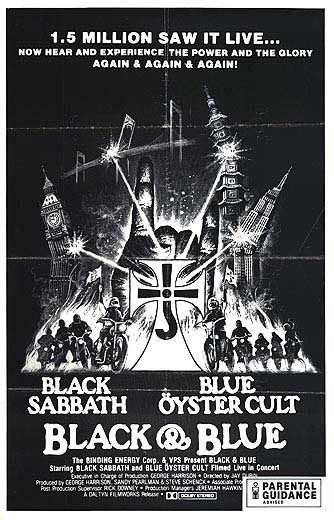
(from chaskelley.wordpress.com)
While bummed over Sabbath’s no-show, I became a life-long super fan of BÖC that night when they came out following a short set by the unremarkable opening band — the all-but-forgotten French hard rockers Shakin’ Street — and announced that they would lengthen their performance to make up for their co-headliner’s absence. Ignoring strong winds and blowing sand at the outdoor desert venue, the Öysters proceeded to play a blistering extended show, offering up two full sets broken up by a short intermission. The first set incorporated multiple cracking new songs from Cultösaurus Erectus, plus fan favorites “Godzilla,” “(Don’t Fear) The Reaper,” “Cities on Flame,” and “ME 262,” among many others. Apologizing for non-existent deficiencies resulting from a lack of rehearsal, singer Eric Bloom then introduced a second set that included inter alia my personal faves “Then Came the Last Days of May” and “Transmaniacon MC,” as well as a cover of the Beatles’ “I Want You (She’s So Heavy).” The ad hoc nature of the second set was proven as the band appeared to decide what to play on the fly, with Bloom offering up long explanations of where individual songs came from and how long it had been since they’d been regularly played live.
My BÖC dedication continues to this day; I type this just two weeks before planned attendance at a 31 January 2015 show by the band’s current incarnation — which includes only Bloom and guitarist extraordinaire Buck Dharma from the 1980 line-up — at the tiny Tally Ho Theater in Leesburg, Virginia. I can’t wait!
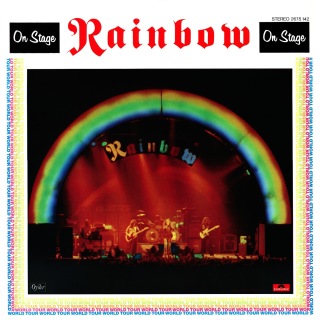
My next successful missing of Ronnie James followed a few months later, although this time I was actually years behind the curve as opposed to the few days of the “Black and Blue” miscarriage of cosmic justice. I saw the band Rainbow at Salt Lake City’s Salt Palace on 29 March 1981 on a bill that also included the Pat Travers Band (from which, on theme, co-lead guitarist Pat Thrall sadly had departed a few months prior). While Rainbow was touring on the back of their then-new album Difficult to Cure, which boasted the talents of vocalist Joe Lynn Turner, the only Rainbow LP I owned at the time was a used copy picked up on the cheap from the Deseret Industries Thrift Store of the live double album On Stage, which had been recorded in 1976 when Ronnie James was in the band. Rainbow played only three Dio-era songs during the concert I saw, but I was pleased that two of them, “Man on the Silver Mountain” and “Catch the Rainbow,” also appeared on On Stage.
 In hindsight, I wish I could say I spent the evening pining for Dio’s honeyed tones, but the truth is I was there to see guitar hero Ritchie Blackmore and was relatively unconcerned about who accompanied him. I do remember being impressed with Turner and a couple of solos played by keyboardist Don Airey — whose name meant nothing to me at the time — but for the most part my attention was firmly on the guitar god at right side of the stage. He was dressed in black and seemed moody that night, thus awesomely living up to his legend. I am somewhat embarrassed to admit complete obliviousness to the presence of then former Deep Purple bassist Roger Glover, although I vaguely remember a bass solo.

Rainbow in concert circa 1982 (from webdj.co)
Besides the Dio-era tunes, highlights of what I recall as a too-short set by Rainbow included a cover of Jimi Hendrix’s “Fire,” an extended encore performance of Purple’s “Smoke on the Water,” and the instrumental workout “Difficult to Cure,” Blackmore’s cranked-up take on Beethoven’s Ninth Symphony. The whole show was fantastic, although as it turned out I think I actually came away slightly more impressed by Pat Travers and company. I undeniably ignored the importance of Ronnie James to Rainbow during my enjoyment of that 1981 show, although I would note in my defense that I subsequently owned all the Dio-era Rainbow albums at least a decade before adding any of the band’s post-Dio recordings to my stacks.
An aside for an obligatory full-disclosure disclaimer: I do not mind — and could even be correctly described as “liking” — Blackmore’s Night, Ritchie’s current Renaissance Fair-style medieval folk rock outfit with his multi-instrumentalist/vocalist spouse Candace Night.
It would be another 28 years before my third “missing” of Ronnie James Dio. On 1 August 2009, my son and I saw Big Elf, Zappa Plays Zappa, Queensrÿche, and Dream Theater at Merriweather Post Pavilion in Columbia, Maryland. It was to be my last show with my boy before our lives would evolve considerably with him heading off to college and my departing for a one-year unaccompanied (i.e. without family) assignment in Afghanistan. The concert was fantastic and we were hyped as we walked back to the car afterwards to find under the windshield wiper a flyer for an upcoming show featuring Maryland’s own Kix opening for Judas Priest and the Dio-fronted version of Black Sabbath reunited under the legally-allowable moniker Heaven & Hell. Much to our chagrin however, the concert was to occur on 22 August, roughly two weeks after my scheduled departure for South Asia. Lamenting the bad luck on timing, we consoled ourselves with the knowledge that there would certainly be future opportunities to see Heaven & Hell following my return home in August 2010. Cold fate intervened however as Ronnie James Dio succumbed to cancer — a truly uncaring, undifferentiating satanic evil — on 6 May 2010, dooming all of us to miss him continually forevermore.
So, in the end, drugs, creative differences, terrorism, and death all contrived together for the sole purpose of blocking me, VotF, personally from ever experiencing the glory of Ronnie James Dio live. How freaking rock and roll is that?!?
I have concurrently been here forever and only just arrived. These final 48 hours of my stint in Karachi, Pakistan, crawl along at a snail’s pace, a seeming infinite eternity still in front of me before I finally find myself on that homeward-bound plane that will reunite me with family, country, and my “real life.” At the same time, it seems just yesterday that I white-knuckled it through my initial solo drive from work to home on that first day of 2014, watching my new world pass by from inside my fully-armored mobile cocoon, praying that I’d not miss a turn and end up wheels deep amongst the decapitators I imagined lurking in the city’s dark recesses. The 365 days in between are a foggy blur of success, frustration, loneliness, accomplishment, over-stimulation, boredom, failure, satisfaction, monotony and excitement. I fully expect to miss everything and nothing.
I bounce between giddiness at the gradual passing of reins over to my relief and resentment that I am so indifferently replaced. I pine for landfall but bristle at turnover of the ship’s captaincy. As I drag myself home each night in these last days, my brain weighs down my eyelids, sending me early to bed only to then pummel me with a fitful sleep full of varied nightmares. I face a mix of torture, naked pop quizzes, cuckolding, and desperately-needed but forgotten trinkets of inexplicable importance on a nightly basis.

I will fly out via Jinnah International Airport, scene of a June attack by Uzbek extremists that killed, among others, some of the poor folk who ensured I received my Amazon Prime orders via Consulate mail pouches. My final professional interactions will include the offering of renewed inadequate condolences to local counterparts for over a hundred schoolchildren slaughtered by fanatics in Peshawar on 16 December. I will carry back home the “cool” story of the night a car bomb targeting a passing senior police official shook the windows of my flat; I thought the tremor related to nearby construction until turning on the news.

But my time also overlapped with the awarding of the Nobel Peace Prize to young Malala Yousafzai, who has become an international icon promoting the human right to education after recovering from a bullet to the head delivered by Tehrik-e Taliban Pakistan militants displeased with girls going to school. I have a daughter just a bit older than Malala. I count my blessings and/or celebrate my luck daily, preferred cosmology left to the reader’s choice.

My own impact and professional achievements over these 12 months have included … well, that’s for others to determine. I didn’t screw up and believe I leave my thing better than I inherited it and without hidden turds for those that follow after me to find.
On the personal front, I am pleased to have accomplished a long-held goal of watching all seven seasons of Buffy the Vampire Slayer. Let him who hath not understanding get with the program. Buffy rules! I also discovered – or at least followed up on a decade-old recommendation from a now long-lost friend about – author John Barth, whose novels The Floating Opera and The End of the Road awed and disturbed me. I treaded on the mill regularly, completely gave up soda pop, and found myself capable of fad-free healthier eating for the first time in my 50 years.
I will remember Karachi, although not immediately; I can already feel myself purging as I wind down. I suspect however that time and distance will eventually do their magic and fond memories will evolve. For now though, I am so damn glad to be on the verge of departing that I can think of little else. I cannot wait to once again be contentedly inattentive to my surroundings. I long to be unaware, to be oblivious, to be home.
For three-plus decades I have fondly remembered the precise instant when I first allowed that there might be something worthwhile in that strange punk rock movement that was blossoming in the latter half of the 1970s. I’ve cherished and coddled the memory, proudly recalling the invigorating nascent twinge of anti-establishment feeling birthed within me as the event unfolded. The specific song that opened my eyes has remained a strong favorite, still regularly finding its way onto CD “mix tapes” gifted to friends and loved ones even as I enter my second half century. I always knew I’d eventually write about it, viewing it as one those epic moments in my personal musical life journey.
And now suddenly, terribly, I discover that the moment never happened, at least not as I so clearly recalled it. I had never doubted. I knew my treasured memory was real. But truth has failed me; “fact” has betrayed me. Some may read and deem me an over-reacting drama queen (king?), but they should first seek not to judge. Even minor tweaks to established personal gospels can be hard to swallow for true believers like me.
By that winter of my 13th year in December 1977, I was mainly aware of punk rock through breathless morning TV news stories about those crazy Sex Pistols and their safety-pin-bedecked, unwashed followers in that strange, foreign land called London. At least in my age group, and certainly on local Utah radio, “punk” music had made no inroads. At the time, I don’t think I’d ever even heard of punk pioneers The Ramones or Patti Smith, let alone any of the wave of punk rockers that offered up first albums in 1977 that would eventually become rock canon. Back then, I most assuredly had no time for Johnny Rotten and his self-cutting, gob-spitting acolytes and their tuneless shouting.

Not Utah in 1977 (from stylehunterman.com)
Here’s what my brain says happened: As I’d done since the show premiered in 1975, I struggled to stay awake long enough that night to watch Saturday Night Live on NBC. Besides wanting to laugh at jokes many of which I didn’t quite understand but knew were somehow pushing boundaries, it was imperative that I not find myself at school on Monday morning unable to recite the best skits and be deemed a wuss whose mommy probably tucked him in at 8:PM. As I watched that night’s episode, skinny English punk rockers Elvis Costello and the Attractions were introduced as the musical act. They started to play some song I didn’t recognize when suddenly, seemingly quite angrily, Elvis stopped the band mid-note and sneered into the microphone that there “was no reason to play that song here” before launching into the song……… “Watching the Detectives.”
The mixture of Costello’s angry young man demeanor, hyperactive manner and staccato lyric delivery, and the infectious groove, shuffling drums, and tightly picked electric guitar notes in the reggae-influenced Watching the Detectives was a revelation. I had no idea to whom Elvis was flipping the bird by playing this particular song on U.S. TV nor why he had needed to be so “punk” in forcing it onto our screens against the will of “the man,” but I knew his action was heroic. It was all just so damn cool. Maybe this punk stuff had potential…
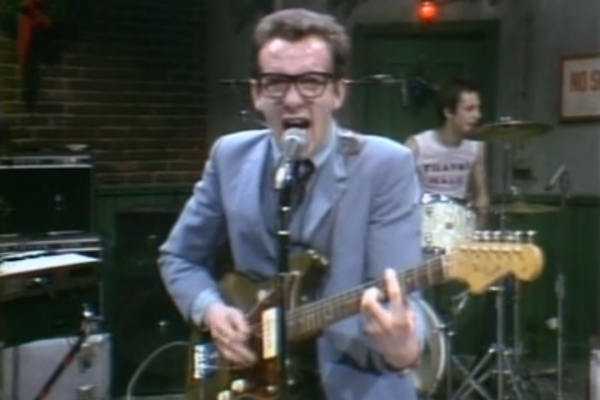
Angry Elvis Giving It to the Man on SNL, 1977 (from ultimateclassicrock.com)
It would be years before I actually owned any Elvis Costello, but Watching the Detectives would be part of me forever from that day forth. I knew I wouldn’t need to actually listen to it ever again for it to remain near the top of my mind’s internal most played list.
Here’s what science says actually happened: Elvis Costello and his band indeed played Watching the Detectives that night, but during their first slot on the show. It was during their second performance later in the episode that Elvis stopped after a few bars of new single Less Than Zero, to make his “no reason” statement before leading the band into the song Radio, Radio, a screed against “corporate” media force-feeding musical and other entertainment pabulum to the masses.
I’m devastated. My joy at Watching the Detectives has been subconsciously reinforced for more than thirty years by its obvious dangerousness as demonstrated by Elvis’ foisting, against-their-will performance of it in which I had participated as an observer on that late winter’s night. I had been there when it was first launched as a grooving shot across the unsuspecting bow of the old tight-ass bastards, whoever they were, who were keeping us young ones down. Radio, Radio is an ok enough song I guess, but hell, I wouldn’t even list it among my top 25 favorite Elvis Costello songs. How could it have been the moment?
I now find myself doubting whether the moment actually occurred in any form. Trust in myself is fractured. My whole belief system is on the verge of collapse. I wonder who the hell I even am anymore. Is my whole existence just a pile of lies?
In the meantime, Watching the Detectives is a freaking fantastic song. Check it out:
And when your fingers find her, she drowns you in her body, Carving deep blue ripples in the tissues of your mind.
The above lines are taken from the song Tales of Brave Ulysses by Cream, which is inspired by Homer’s Odyssey according to the lazy man’s research assistant Wikipedia. For me however, the couplet has always seemed the perfect description of the intense effect music has when I really allow it inside; it drowns me in its depths, carrying my oft-troubled mind far from worries and leaving ripples in my memories that soundtrack the moments that make up my life. Indeed, these blog entries serve as evidence of the beautiful mind carvings left behind over the years by my treasured music. While he didn’t write them, it was Cream bassist and vocalist Jack Bruce that gave voice to the above words, a portion of which have sat atop this blog’s header since the day I started it.

I learned today of Jack Bruce’s death at the age of 71. As I read a few online eulogies and news reports of his passing, I thought about my own experience with his music. While I’m sure there are some other personal reminiscences like mine out there, I have not seen the particular path I took to Jack Bruce cited in any major outlets.
I came to Jack Bruce via his exhilarating early 80s work with Robin Trower. Sure, I had a couple of Cream albums before that, counting the opening one-two punch of Strange Brew and Sunshine of Your Love on Cream’s Disraeli Gears album as ranking among the best heavy rock ever recorded. But at the time, Cream for me was one of the many Eric Clapton projects enjoyed by my teenage self; I was aware of and appreciated, but never really thought much about, Jack Bruce’s role (an error of which I have since repented).
When, in 1981, my then (and still) personal most venerated artist/guitarist/musician of all time, Robin Trower, came out with the B.L.T. album on which Bruce and drummer Bill Lordan joined him in a power trio format, I began to give Jack Bruce his due. I finally took notice of the unique beauty of his immediately-recognizable voice and the groove of his playing style. His era-defining bass has a funkiness and bounce that can really be heard on the album. In fact, I believe that B.L.T. and its follow up from 1982, Truce, are among the very best recordings of Bruce’s bass available.
On both albums, the bass is high in the mix, sharing the spotlight with Trower’s guitar while never failing to provide the bottom-end foundation that holds things together. The separation of the bass and guitar achieved by the engineer is genuinely amazing, and contrasts positively with many other Bruce recordings — such as in Cream’s discography — in which his playing thrills but is often layered within the overall sound, robbing it of some of its torque. Bruce doesn’t get much songwriting credit on either album, but his vocals and bass are integral to each and every song.


I’ve chosen below one song each from B.L.T. and Truce, Life on Earth and Fat Gut respectively, that were written or co-written by Bruce. They aren’t the LPs’ best tunes, but I figure they are fitting choices in honor of Jack’s departure from our earthly plane. The third song, End Game off of B.L.T., is a blues scorcher that demonstrates how Bruce’s bass can both support and sit proudly alongside even the most raging electric guitar, showing why so many fantastic guitarists like Trower, Eric Clapton, Leslie West, and Gary Moore chose to make music with him.
LIfe on Earth
Fat Gut
End Game
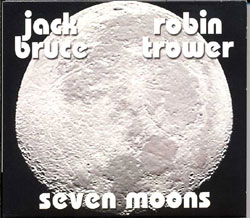
Bruce and Trower came together again in 2009 for Seven Moons, another fantastic album with a relatively more moody and emotional bent than the early 80s records. Unlike those previous LPs, Bruce co-wrote with Trower each of the album’s songs. As a result, they are less insertions of Bruce’s awesome talent into Robin Trower’s music and more reflections of the man himself. The tunes are generally slower and have something of an ethereal feeling, without leaving behind any of their heavy rock legacy. Jack’s 66-year-old voice is as strong and distinctive as ever and, while the bass is not as “separated” as on the 80s recordings, it is still mixed high and forcefully carries its weight. The album demonstrates that Jack Bruce never lost it, was not content to sit on his laurels, and remained a creative and musical prodigy long into his elder statehood.
Following the release of Seven Moons, Bruce and Trower, along with drummer extraordinaire Gary Husband, embarked on a short concert tour in Europe. A Dutch show on that tour was filmed and released on DVD as Seven Moons Live. I obtained it while serving a one-year assignment in the Afghan hinterlands, and it gave me many hours of reassurance and joy in difficult circumstances far from family and home. Seeing these two old men — and they were definitely old men as seen in the embedded video below — generating such beautiful, intricate and sumptuous music, and clearly enjoying themselves so much while doing it should serve as a model for all of us. There does not have to be anything sad about aging; the additional fermenting doesn’t preclude our continued ability to learn and create, and to bring joy to ourselves and others.
Farewell and thank you, Jack. Your earthly odyssey has ended, but the deep blue ripples remain.


 Victim of the Fury